Welcome to visit Hoyogo website, let's connect the world together!
Customer service hotline:+86 13723413985 or 400 058 2288
With advances in artificial intelligence, machine vision, and industrial automation, some industrial PCs are incorporating local AI inference capabilities to meet the growing demand for on-site data processing and intelligent analysis. In applications such as smart manufacturing, industrial vision inspection, equipment condition monitoring, and automated production lines, AI industrial PCs can process data and perform model inference locally, reducing dependence on cloud computing resources while meeting industrial requirements for real-time response and stable operation.
Compared with conventional industrial PCs, AI industrial PCs may incorporate higher-performance processors, GPUs or dedicated AI acceleration modules, high-speed storage, and various industrial communication interfaces, depending on their computing performance requirements. These components place greater demands on PCB signal transmission, power distribution, interconnection density, and long-term reliability. As essential platforms for mounting electronic components and providing electrical interconnections, PCBs play a critical role in the operational stability of industrial computing equipment.
HoYoGo is a professional AI Industrial PC PCB manufacturer with capabilities in high-reliability, high-precision, multilayer, and high-speed PCB manufacturing. To meet the needs of industrial edge computing, machine vision, and intelligent automation equipment, the company focuses on circuit fabrication accuracy, impedance control, interlayer connection quality, and material processing stability, providing customized PCB manufacturing services according to customer technical specifications.
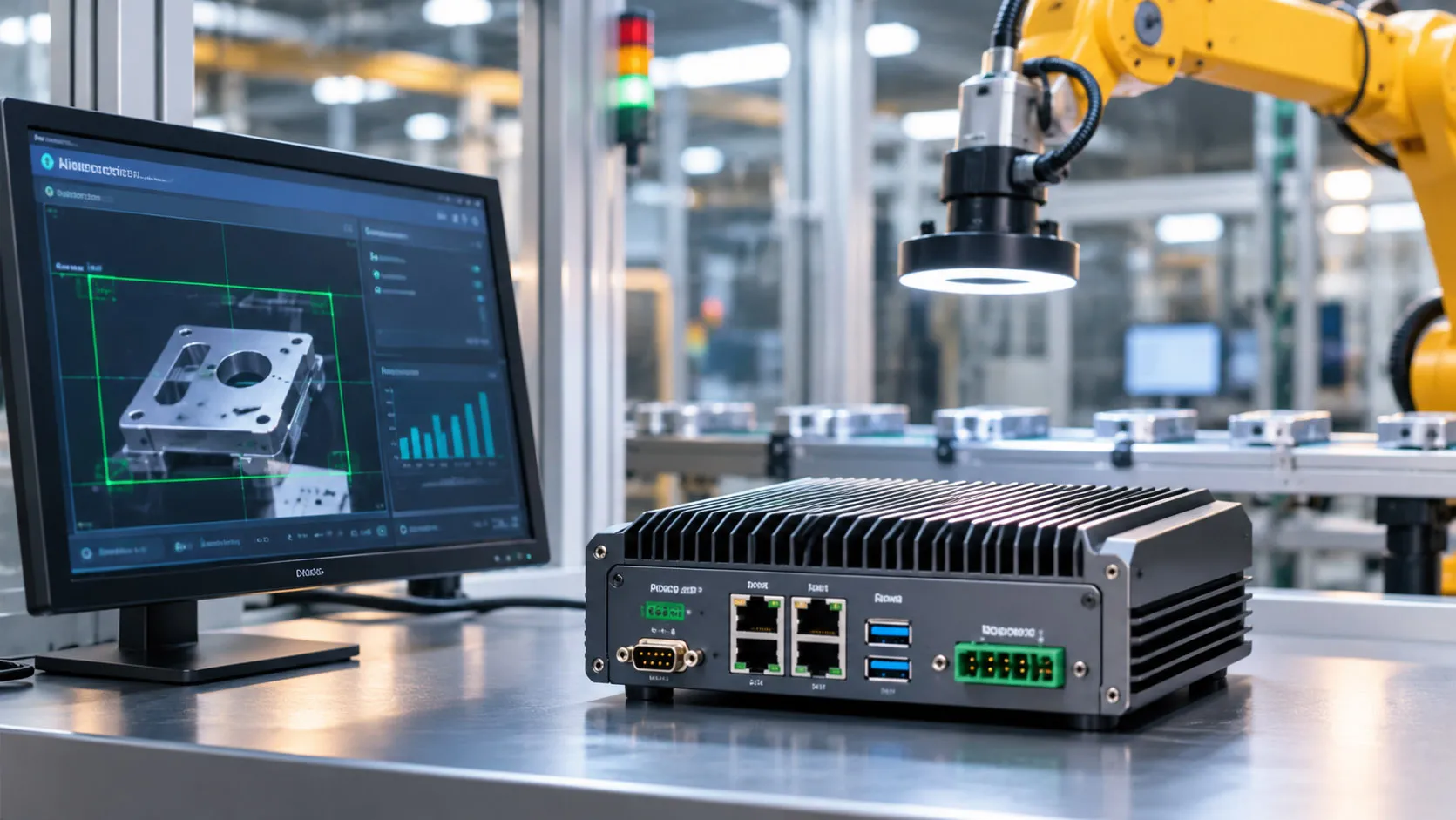
High-Speed Signal Transmission and Precision Circuit Fabrication
In industrial vision inspection, equipment monitoring, and other on-site data processing applications, AI industrial PCs can process data generated by industrial cameras, sensors, and related devices locally. Some products also need to support PCIe, high-speed Ethernet, and high-speed storage interfaces. As data transfer rates and board-level integration increase, variations in PCB trace dimensions and impedance can have a greater impact on high-speed signal transmission.
During PCB manufacturing, trace impedance is influenced by factors such as trace width, differential pair spacing, finished copper thickness, dielectric thickness, and material dielectric constant (Dk). Manufacturers must control circuit etching precision, finished copper thickness, and dielectric thickness after lamination according to customer-specified stack-up structures and impedance requirements. They must also consider the reference plane configuration and dielectric properties of the materials to ensure that impedance requirements are met. For products requiring controlled impedance, impedance testing must also be performed in accordance with customer technical specifications to verify that the actual impedance values meet the specified tolerances.
Multilayer PCBs and High-Density Interconnections
Depending on the product architecture, AI industrial PCs may integrate CPUs, GPUs, or dedicated AI accelerators, along with memory, storage, and industrial communication modules. As computing performance and interface integration increase, some high-performance AI industrial PCs require more PCB layers, finer circuit features, and higher interconnection density to accommodate high-speed signal transmission, power distribution, and component interconnections.
Multilayer PCB manufacturing involves inner-layer circuit fabrication, lamination, drilling, and copper plating in holes. Layer-to-layer registration errors can affect the alignment of drilled holes with inner-layer pads, while the thickness, uniformity, and integrity of copper plating on hole walls directly affect interlayer connection reliability. For products incorporating blind vias, buried vias, or other high-density interconnection structures, fabrication accuracy and hole metallization quality must be controlled according to customer technical specifications to reduce the impact of manufacturing defects on product reliability.
Material Selection and Thermal Reliability
AI industrial PCs are commonly deployed on factory floors, inside automated equipment, or in industrial control cabinets. Some applications involve substantial temperature fluctuations, mechanical vibration, or limited space for heat dissipation. Heat generated by high-performance processors and AI acceleration modules during operation may also raise temperatures in localized areas of the PCB. For industrial computing equipment with higher power demands, PCB thermal management may also involve appropriate copper thickness, copper plane layout, and thermal vias to improve heat conduction in localized areas. Specific structures should be determined according to the equipment's power requirements, thermal design, and customer specifications.
For different industrial operating environments, PCB manufacturing must account for substrate glass transition temperature (Tg), coefficient of thermal expansion (CTE), and heat resistance. Differences in thermal expansion among PCB materials can generate thermomechanical stress during temperature changes, potentially affecting dimensional stability and interlayer connection reliability. Manufacturers must control lamination and hole metallization quality according to customer-specified material requirements to ensure that interlayer bonding and plated-through-hole connections meet the specified reliability requirements.
For products with higher data transfer rates or stringent channel loss requirements, material dielectric constant (Dk), dissipation factor (Df), and copper conductor surface roughness also require attention. Manufacturing variations must be controlled with consideration for the processing characteristics of the selected materials.
Long-Term Reliability in Industrial Environments
Compared with typical consumer electronics, AI industrial PCs are generally expected to operate reliably for extended periods. Some equipment must also withstand mechanical vibration, temperature and humidity fluctuations, and repeated startup and shutdown cycles. These conditions may affect PCB structural integrity, interlayer bonding, and plated-through-hole reliability, while also placing higher demands on the long-term stability of component solder joints, connectors, and PCB mounting areas.
During manufacturing, attention must be given not only to circuit fabrication and hole metallization quality but also to substrate processing stability, solder mask quality, and surface finish consistency. For products with specific environmental resistance requirements, applicable thermal stress testing, temperature cycling tests, or other reliability verification should be conducted according to customer technical specifications. These tests help assess PCB structural integrity and electrical connection reliability under specified conditions.
Volume Manufacturing and Product Consistency
AI industrial PCs are widely used in industrial automation and equipment control, where systems often have long service lives. For PCBs manufactured in volume, meeting the dimensional, impedance, and electrical performance requirements of individual boards is only part of the challenge. Manufacturers must also control quality variations between production batches.
PCB manufacturers should strengthen raw material batch management and control of critical manufacturing processes. Dimensional inspection, electrical testing, and impedance testing where required must be performed according to customer technical specifications. Production parameter records, inspection data analysis, and traceability of quality issues help manufacturers identify and address fabrication deviations, supporting consistent quality across production batches.
Development Trends in PCBs for AI Industrial PCs
As edge AI computing, industrial machine vision, and intelligent automation continue to develop, AI industrial PCs are evolving toward higher computing performance, a wider range of industrial interfaces, and more compact form factors. Requirements for PCB layer count, circuit precision, material properties, and environmental reliability vary across applications, creating increasingly diverse manufacturing demands.
Precision circuit fabrication, multilayer interconnection processes, material processing stability, and volume production quality control will remain important aspects of PCB manufacturing for AI industrial PCs. For equipment intended for long-term deployment in industrial environments, manufacturers must address both high-speed transmission requirements and reliability under demanding operating conditions.
As a professional AI Industrial PC PCB manufacturer, HoYoGo specializes in high-reliability, high-precision, multilayer, and high-speed PCB manufacturing, providing customized PCB manufacturing services based on the requirements of different industrial computing applications. Production and quality control are carried out in accordance with applicable IPC standards and customer technical specifications, with particular attention to the stability of critical manufacturing processes, interlayer connection reliability, and batch-to-batch consistency. HoYoGo provides reliable PCB manufacturing support for AI industrial PCs and related industrial automation equipment.


 English
 Français
 Deutsch
 Português
 Pусский
 中文
