Welcome to visit Hoyogo website, let's connect the world together!
Customer service hotline:+86 13723413985 or 400 058 2288
As AI model training, high-performance computing, and data center operations continue to expand, the volume of data exchanged within AI servers is increasing, placing greater demands on high-speed interconnect bandwidth and transmission reliability. PCI Express (PCIe) is a key high-speed interconnect standard used in servers. It enables high-speed data communication between CPUs and components such as GPUs, AI accelerator cards, and high-speed storage devices. As PCIe interface speeds increase, the associated PCBs face more stringent requirements for material properties, signal transmission quality, and manufacturing precision.
PCIe 5.0 operates at 32 GT/s per lane using non-return-to-zero (NRZ) signaling. PCIe 6.0 increases the transfer rate to 64 GT/s per lane, introducing four-level pulse amplitude modulation (PAM4), Flit mode, and forward error correction (FEC). PCIe 7.0 further raises the per-lane transfer rate to 128 GT/s, continuing to use PAM4 signaling and Flit-based encoding. At these higher speeds, channel loss and impedance deviations have a greater impact on signal integrity, making PCB manufacturing tolerance control increasingly demanding. As essential components of server motherboards, accelerator cards, and other high-speed interconnect boards, PCBs directly influence board-level electrical performance and long-term reliability through their manufacturing quality.
To address the manufacturing requirements of AI server PCIe PCBs used in high-speed interconnect applications, HoYoGo develops appropriate manufacturing processes based on customer-specified material requirements, stack-up structures, and technical specifications. Particular attention is given to critical manufacturing parameters and multilayer interconnection quality to meet high-speed signal transmission and long-term reliability requirements.
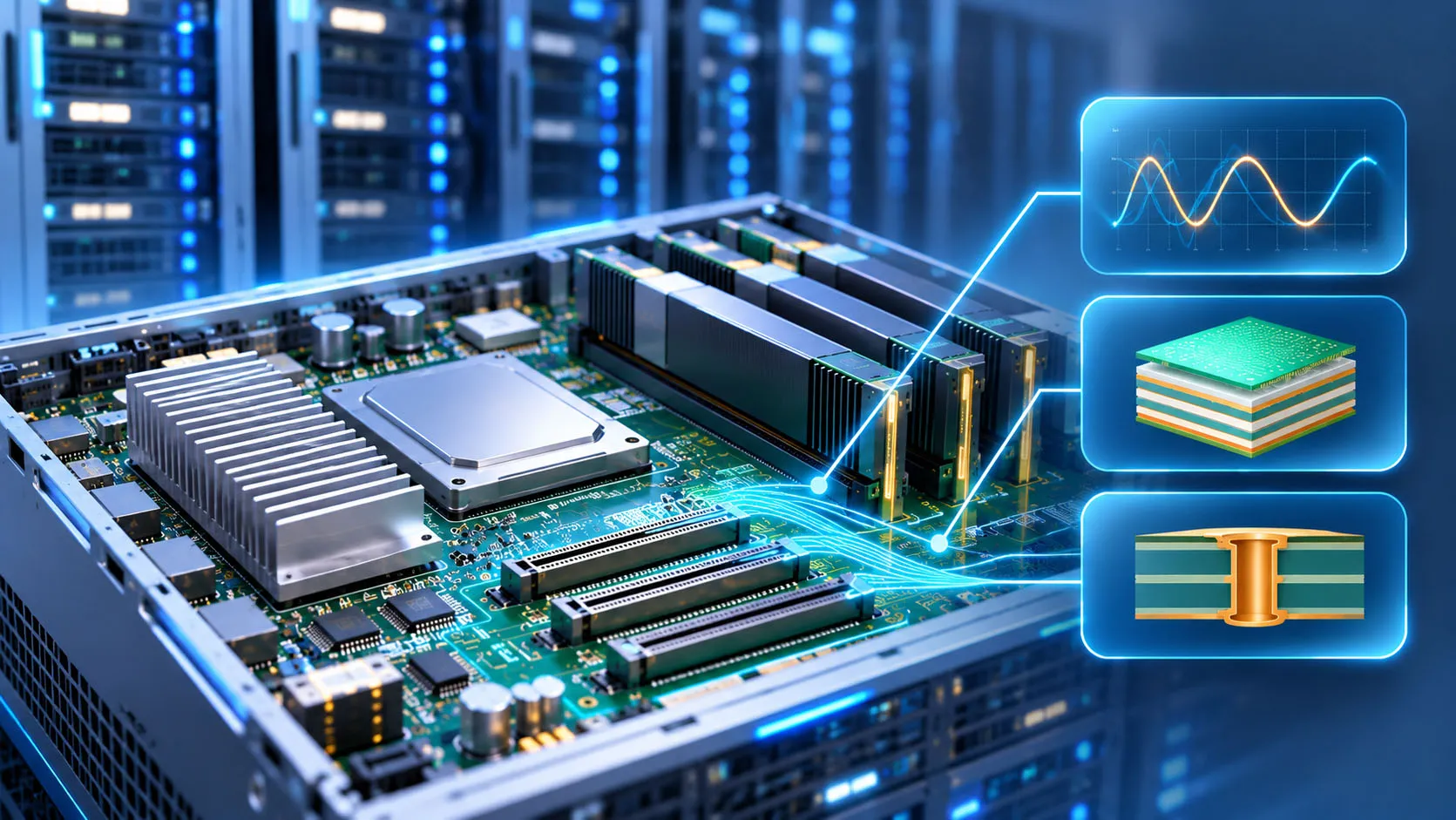
High-Speed Signal Transmission and Impedance Control
PCIe uses high-speed differential signaling. As interface speeds increase, PCB impedance deviations, transmission loss, and impedance discontinuities have a greater impact on signal integrity. For server boards incorporating PCIe 5.0 or higher-speed interfaces, PCB manufacturing requires tighter control of trace dimensions, dielectric thickness, and impedance tolerances to meet the electrical performance requirements of high-speed transmission channels. In addition, consistency in differential trace width and spacing is important for maintaining differential impedance and signal transmission quality, requiring close control during PCB fabrication.
During PCB manufacturing, trace impedance is influenced by trace width, differential pair spacing, finished trace copper thickness, dielectric thickness, and material dielectric constant (Dk). For PCBs requiring controlled impedance, manufacturers must control trace dimensions and dielectric thickness according to customer-specified stack-up structures, impedance targets, and technical specifications. Impedance testing must also be performed as required to verify that the finished boards meet the specified impedance tolerances.
Low-Loss PCB Materials and High-Speed Transmission Performance
Transmission loss in high-speed PCIe channels is closely related to PCB material properties. As interface speeds increase, dielectric loss and conductor loss become increasingly significant factors affecting high-speed signal transmission. For server boards with longer transmission paths or stringent channel loss budgets, appropriate low-loss materials should be selected based on operating frequencies and customer-specified channel loss requirements to reduce dielectric loss. Copper conductor surface roughness and trace fabrication quality should also be controlled to limit conductor loss.
PCB manufacturers must follow customer-specified material requirements and technical specifications, with particular attention to dielectric constant (Dk), dissipation factor (Df), and copper conductor surface roughness. Materials differ in lamination characteristics, dimensional stability, and processing compatibility. During manufacturing, dielectric thickness, interlayer bonding, and circuit fabrication quality must be controlled to ensure that the finished PCBs meet the specified material, dimensional, and electrical performance requirements.
Multilayer PCBs and High-Density Interconnections
AI servers typically integrate multiple processors, accelerator cards, and high-speed interfaces. Their motherboards and expansion cards may therefore require multilayer PCBs with higher layer counts to accommodate high-speed signal transmission, power distribution, and component interconnections. As interface density increases in certain server boards, requirements for layer-to-layer registration accuracy, drilling quality, and multilayer interconnection reliability also become more stringent.
Multilayer PCB manufacturing involves critical processes such as inner-layer circuit fabrication, lamination, drilling, and hole metallization. Layer-to-layer registration errors can affect the alignment of drilled holes with inner-layer pads, while the thickness, uniformity, and integrity of copper plating on hole walls influence the reliability of interlayer electrical connections. For high-speed PCBs requiring backdrilling, manufacturers must control backdrill depth and residual via stub length according to customer technical specifications. This helps reduce signal reflections caused by nonfunctional via stubs and improve high-speed channel performance, while avoiding damage to functional connection layers during processing.
Thermal Conditions and Long-Term Reliability
AI servers typically operate under high computing loads for extended periods. Heat generated by processors, accelerator cards, and power management components may raise temperatures in localized areas of the PCB. Because the materials within a PCB have different coefficients of thermal expansion, temperature changes can generate thermomechanical stress. Repeated thermal fluctuations over time may affect the reliability of interlayer bonding and plated interconnection structures.
To meet the long-term operating requirements of AI servers, PCB manufacturers must consider the substrate's glass transition temperature (Tg), coefficient of thermal expansion (CTE), particularly the Z-axis CTE, and heat resistance based on customer-specified operating temperature ranges and reliability requirements. Lamination and hole metallization quality must also be controlled. Where required, applicable reliability verification, such as thermal stress testing or temperature cycling, should be conducted according to customer technical specifications to assess PCB structural integrity and interconnection reliability under specified environmental conditions.
Volume Manufacturing and Quality Consistency
AI server motherboards, accelerator cards, and related high-speed interconnect boards commonly use multilayer PCB structures, with some products requiring tight impedance control and manufacturing tolerances. During volume production, trace dimensions, dielectric thickness, and interlayer connection quality must consistently meet specified technical requirements across production batches to maintain the electrical performance and assembly consistency needed for high-speed interconnections.
PCB manufacturers must strengthen raw material management, critical process control, and in-process inspection to maintain manufacturing stability. Dimensional inspection and electrical testing should be conducted according to customer technical specifications, with impedance testing performed for PCBs requiring controlled impedance. Monitoring critical manufacturing parameters and maintaining raw material batch and production records help reduce quality variations between batches and ensure product traceability.
AI Server PCIe PCB Manufacturing Trends
As PCIe interfaces evolve toward higher transfer rates, PCB manufacturing for AI servers faces increasing demands for material processability, fine-line fabrication control, and multilayer interconnection quality. In particular, PCIe 6.0 and 7.0 applications using PAM4 signaling place stricter requirements on channel loss, impedance continuity, and manufacturing consistency.
Different PCIe interface speeds and server board structures require different PCB materials, stack-up configurations, and manufacturing processes. PCB manufacturers must control critical process parameters according to customer-specified material requirements, stack-up structures, and technical specifications to ensure that finished boards meet the applicable electrical performance and reliability requirements.
HoYoGo is a professional AI server PCIe PCB manufacturer specializing in high-reliability, high-precision, multilayer, and high-speed PCB manufacturing. The company develops PCB manufacturing processes based on customer-specified product structures, material requirements, and reliability criteria. Production and quality control are carried out in accordance with applicable IPC standards and customer technical specifications, providing reliable PCB manufacturing support for AI servers, high-performance computing systems, and data center equipment.


 English
 Français
 Deutsch
 Português
 Pусский
 中文
