Welcome to visit Hoyogo website, let's connect the world together!
Customer service hotline:+86 13723413985 or 400 058 2288
With the continuous advancement of automotive intelligence, automotive GPS systems have become an important component of modern automotive electronic architecture. Automotive GPS systems receive satellite signals and combine them with onboard navigation algorithms to provide real-time positioning and route planning information, effectively improving driving convenience and road safety.
As automotive systems continue to develop toward miniaturization and higher integration, greater demands are placed on space utilization, weight control, and long-term reliability. With advantages such as lightweight structure, bendability, and flexible circuit layout, flexible PCBs have gradually become one of the commonly used PCB solutions in automotive GPS modules. They can effectively adapt to complex structural layouts while improving system integration. As a flexible PCB manufacturer, HoYoGo has extensive experience in high-precision flexible PCB manufacturing, automotive-grade material application, and reliability control. We provide stable and reliable flexible PCB products for automotive GPS and communication modules.
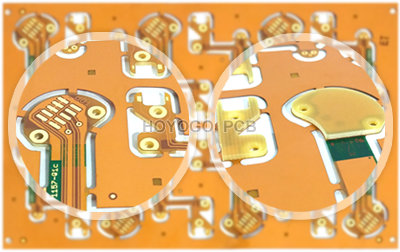
1. Basic Characteristics and Advantages of Flexible PCBs
A flexible PCB is a type of printed circuit board manufactured using flexible base materials (such as polyimide or polyester). Compared with traditional rigid PCBs, it offers the following advantages:
1) Flexibility and Bendability:
Flexible PCBs can be bent and folded according to spatial layout requirements, allowing them to adapt to complex structural environments. This makes them particularly suitable for space-constrained and compact applications such as automotive GPS modules.
2) Lightweight and Thin Design:
Compared with traditional rigid boards, flexible PCBs are thinner and lighter, helping achieve miniaturization of automotive GPS devices while improving internal space utilization.
3) High-Density Capability:
Flexible PCBs can support the integration of more functions, meeting the performance requirements and compact structural needs of automotive GPS modules.
4) High Temperature and Vibration Resistance:
Flexible PCBs are made with heat-resistant flexible base materials, providing good thermal stability and vibration resistance. This allows them to withstand complex automotive environments involving temperature fluctuations, humidity, and vehicle vibration.
5) Reliability and Durability:
With stable material properties and structural characteristics, flexible PCBs can maintain consistent performance during long-term operation, reducing the impact of temperature changes and mechanical stress and ensuring the reliable operation of automotive GPS systems.
2. Applications of Flexible PCBs in Automotive GPS Systems
Automotive GPS systems involve several key components, such as satellite antennas, signal processing units, and display modules. In the connection and integration of these components, flexible PCBs play an important role. The following are several major applications of flexible PCBs in automotive GPS products:
1) GPS Receiving Antenna Module
One of the core components of an automotive GPS system is the GPS receiving antenna. Due to the limited space inside vehicles, traditional structures may not easily adapt to complex installation environments. Flexible PCBs can be used in the antenna structure or antenna connection sections, allowing more flexible placement within the vehicle. By optimizing spatial layout, flexible PCBs help maintain stable signal reception while meeting structural requirements. They can also help control the size of the module, making it easier to meet the space utilization demands of automotive systems.
2) Automotive GPS Mainboard and Module Interconnection
The automotive GPS main control unit typically integrates functions such as signal reception, data processing, and communication interfaces. Flexible PCBs can be used to connect the mainboard with display modules, antenna modules, or other functional units, enabling more flexible structural integration. By reducing the use of traditional connecting cables or connectors, flexible PCBs help optimize the internal layout and improve system integration, making the overall structure of the automotive GPS module more compact and stable.
3) GPS Signal Processing Module
The reception and processing of GPS signals is one of the core functions of an automotive GPS system. The signal processing module typically includes high-frequency circuits as well as analog and digital circuits. In this module, flexible PCBs allow for more flexible arrangement within limited space. Flexible PCBs help optimize circuit layout and maintain stable signal transmission while meeting structural requirements, thereby supporting the normal operation of automotive GPS systems.
4) Display and User Interface Module
Automotive GPS systems are typically equipped with touchscreens or other display modules, allowing drivers to view real-time maps, navigation information, and other data. Flexible PCBs used in display and user interface modules can connect the display, touch components, and other elements to the system mainboard, making circuit connections more flexible, compact, and reliable. By using flexible PCBs, the structural layout of the display module can be optimized and space utilization improved, thereby enhancing the overall structural design flexibility of the automotive GPS system.
3. Advantages of Flexible PCBs in Automotive GPS Systems
1) Improved Space Utilization:
Automotive GPS systems must be installed within the limited space inside vehicles. The bendable nature of flexible PCBs allows for more flexible and compact circuit layouts, enabling more efficient use of available space.
2) Reduced Device Weight:
Flexible PCBs feature a thin and lightweight structure, which helps reduce the overall weight of automotive GPS modules while meeting the requirements for lightweight and compact design in automotive devices.
3) Enhanced System Reliability:
With good environmental adaptability in terms of materials and structure, flexible PCBs can maintain stable performance under complex conditions such as high temperatures, humidity, and vehicle vibration, thereby improving the reliability and durability of automotive GPS systems.
HoYoGo is an international, professional and reliable flexible PCB manufacturer specializing in high-precision flexible PCB production. We are committed to providing highly reliable flexible PCB products for the automotive electronics industry. By using automotive-grade base materials and strict process control, we ensure that our products can operate stably in high-temperature, vibration, and other complex automotive environments, providing reliable signal connections and structural support for automotive GPS systems. Through precision manufacturing and rigorous quality control, we help automotive manufacturers improve system stability and positioning signal reliability, providing a solid hardware foundation for intelligent mobility. If you have related requirements, please feel free to contact us.


 English
 Français
 Deutsch
 Português
 Pусский
 中文
中文