Welcome to visit Hoyogo website, let's connect the world together!
Customer service hotline:+86 13723413985 or 400 058 2288
As medical devices continue to evolve toward miniaturization, higher precision, and greater reliability, traditional PCBs are becoming increasingly unable to meet the requirements of advanced medical electronics for signal integrity, dimensional stability, and long-term reliability. Glass PCBs, which use glass as the substrate material and incorporate precision circuit manufacturing technologies, offer low thermal expansion, excellent flatness, superior insulation properties, and strong high-frequency performance. These characteristics make them increasingly suitable for medical diagnostic, therapeutic, and monitoring devices, where stable and precise electrical interconnections are critical.
HoYoGo, as a professional glass PCB manufacturer, with extensive expertise in precision manufacturing and high-reliability production. We provide highly reliable PCB products for a wide range of medical devices, supporting the growing demands of medical electronics for higher performance, miniaturization, and high-density integration.
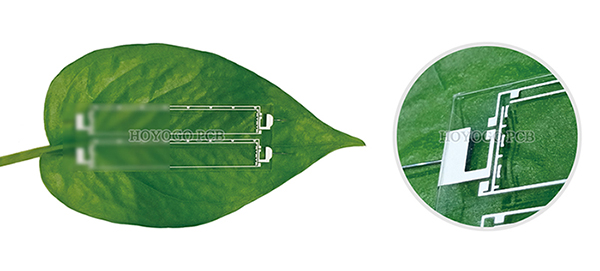
1. What Is a Glass PCB?
A glass PCB is a printed circuit board built on a glass substrate material. One of the core technologies behind glass PCBs is Through-Glass Via (TGV) technology, which uses laser drilling, etching, and related fabrication processes to create tiny vertical vias within the glass substrate. These vias are then filled or metallized with conductive materials such as copper to establish electrical connections between different circuit layers.
By utilizing TGV technology, glass PCBs enable higher-density routing and high-precision interconnect structures while improving signal integrity in high-speed applications. As a result, they are increasingly used in advanced electronic packaging, high-frequency communications, and medical electronics.
2. Key Advantages of Glass PCBs
1) Superior Electrical Performance
Glass PCBs offer excellent high-frequency electrical performance. Thanks to the low dielectric constant and low dissipation factor of glass materials, they can reduce signal loss and transmission interference in high-frequency and microwave applications, helping improve signal integrity during high-speed data transmission. As a result, glass PCBs are well suited for high-frequency and high-speed electronic devices.
2) Excellent Thermal Stability
Medical electronic devices often require long-term reliable operation, and some must withstand high-temperature sterilization or repeated thermal cycling. This places higher demands on the thermal stability and reliability of PCB materials. Glass PCBs offer excellent thermal stability, maintaining stable electrical and mechanical properties across a wide temperature range. This helps improve the long-term reliability of medical devices during extended operation.
3) Low Coefficient of Thermal Expansion (CTE)
Glass PCBs have a low coefficient of thermal expansion (CTE), allowing them to maintain excellent dimensional stability during temperature fluctuations. This helps minimize warping and deformation caused by thermal stress. This characteristic is particularly important for medical devices that undergo repeated high-temperature sterilization or require long-term reliable operation, helping improve PCB reliability and operational lifespan.
2、Specific Applications of Glass PCBs in Medical Devices
1) High-Resolution Medical Imaging Devices
In high-resolution medical imaging systems, high-speed data transmission is required between image sensors and processing chips. Thanks to their low dielectric loss, excellent signal integrity, and a coefficient of thermal expansion (CTE) closely matched to silicon, glass PCBs help minimize signal loss and interference during high-speed transmission, thereby improving the stability and imaging accuracy of medical imaging systems.
2) Medical Monitoring Devices
In medical monitoring devices such as blood glucose meters and respiratory monitors, electronic systems require long-term reliable operation and stable signal transmission. With excellent dimensional stability and thermal stability, glass PCBs provide reliable electrical interconnections that help improve monitoring accuracy and data reliability.
3) Implantable and Life-Support Devices
For implantable medical devices such as pacemakers and neurostimulators, long-term reliability and compact device design are critical. With a low coefficient of thermal expansion (CTE), excellent dimensional stability, and high-density interconnect capability, glass PCBs can meet the stringent reliability requirements of miniaturized medical electronic systems while helping reduce the risk of failure during long-term operation.
In summary, thanks to their excellent high-frequency performance, dimensional stability, and high-density interconnect capability, glass PCBs are playing an increasingly important role in advanced medical electronics. As materials and manufacturing technologies continue to evolve, glass PCBs are expected to gain broader adoption in high-end medical devices, supporting the development of next-generation medical electronics.
HoYoGo is an international, professional, and reliable glass PCB manufacturer with our own production facilities. Backed by extensive production experience and strong precision manufacturing capabilities, HoYoGo provides high-reliability, high-performance PCB products for medical devices, meeting the medical industry’s stringent requirements for reliability and precision.


 English
 Français
 Deutsch
 Português
 Pусский
 中文
中文