Welcome to visit Hoyogo website, let's connect the world together!
Customer service hotline:+86 13723413985 or 400 058 2288
With the development of cloud computing, artificial intelligence, big data, and high-performance computing, the computing power and overall power consumption of data center servers continue to increase. Particularly in AI servers and high-performance computing servers, high-power components such as CPUs, GPUs, and AI accelerators place greater demands on the power delivery capabilities of power supply systems. Server power supplies must achieve stable and efficient power conversion and output within limited space, resulting in higher requirements for power density, conversion efficiency, thermal management, and long-term operating reliability.
PCBs are an important part of server power supply systems. They primarily support component mounting, electrical connections, and current transmission, while also contributing to heat conduction and dissipation. As the power and power density of server power supplies increase, high-current areas on some power supply PCBs need to carry higher currents while withstanding greater thermal stress. This places higher requirements on PCB current-carrying capacity, heat resistance, insulation performance, and manufacturing consistency.
HoYoGo is a professional PCB manufacturer specializing in high-reliability, multilayer, and heavy copper PCB manufacturing. We provide PCB manufacturing services based on the specific application requirements of server power supplies, AI servers, and data center equipment.
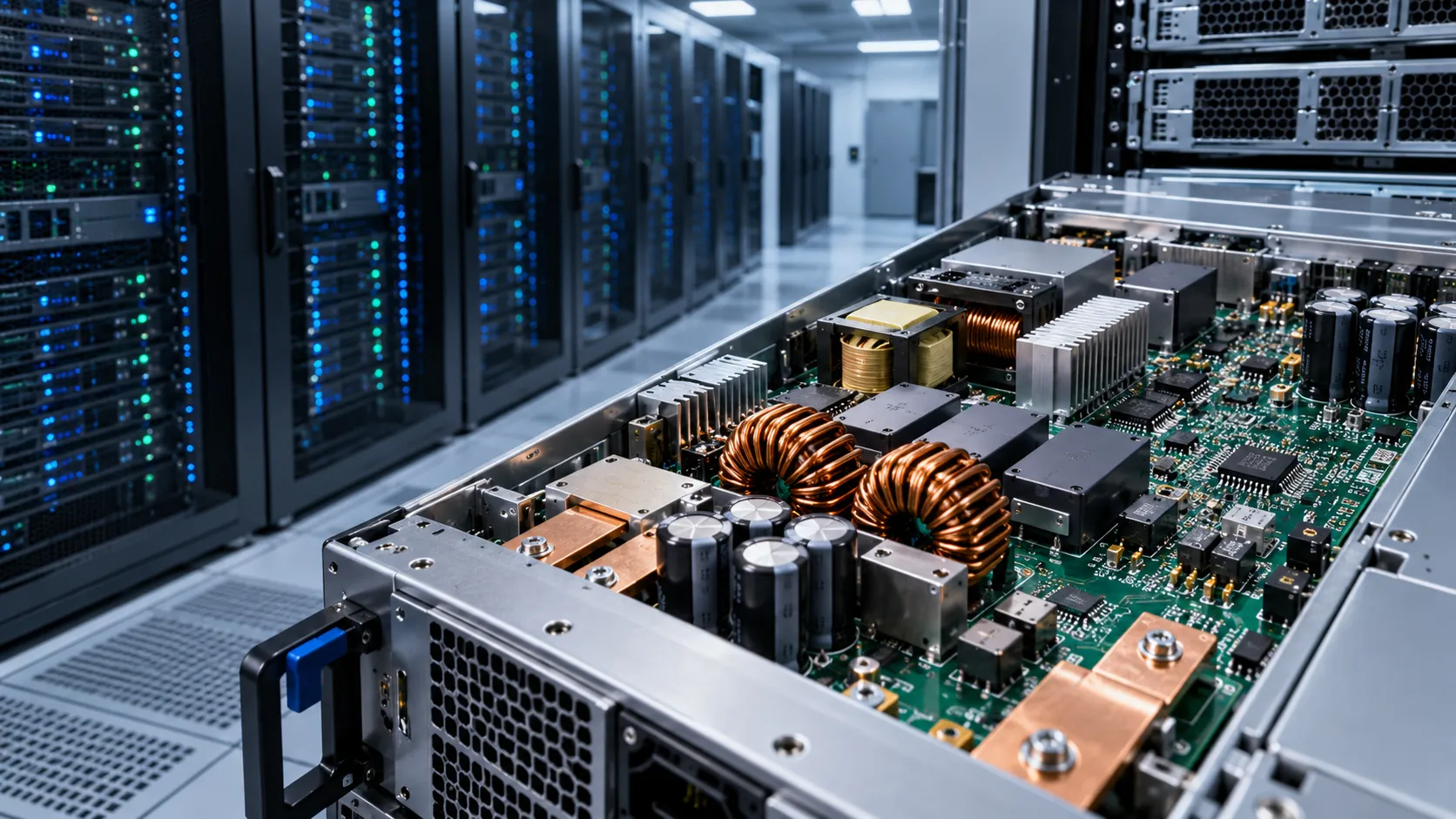
PCBs in Server Power Supply Systems
Server power supplies convert input power into the DC power required by internal server components and provide stable power to motherboards, storage devices, and other functional modules through the corresponding power delivery architecture. For core components such as CPUs, GPUs, and AI accelerators, the low-voltage, high-current power they ultimately require usually needs to be further regulated by board-level power conversion circuits on the motherboard or accelerator card. Compared with ordinary consumer electronics, servers are typically required to operate continuously for extended periods, resulting in higher requirements for power supply stability, conversion efficiency, and long-term reliability.
In server power supply modules, PCBs provide mounting support and electrical connections for power semiconductors, transformers, inductors, capacitors, controllers, connectors, and other components, while also carrying the required current. In high-power, high-power-density server power supplies, PCBs must maintain stable electrical connections during long-term operation and meet product requirements for current-carrying capacity, heat resistance, and insulation performance.
PCB Manufacturing Requirements for High-Current Transmission
In high-performance servers and AI servers, greater power demands place increased current and thermal management pressure on the power supply system. As a result, high-current areas on some power supply PCBs also need to provide sufficient current-carrying capacity and long-term operating reliability.
Copper thickness is one of the key factors affecting the current-carrying capacity of a PCB. For server power supply PCBs with higher current-carrying requirements, an appropriate finished copper thickness can be selected based on product power, current, allowable temperature rise, and other requirements to reduce conductor resistance and transmission losses. The actual copper thickness requirement must also be determined by considering the current path, allowable temperature rise, operating environment, product specifications, and specific manufacturing requirements.
In addition to copper thickness, finished copper thickness consistency, circuit processing accuracy, uniform copper distribution, and plated hole wall quality must also be strictly controlled. Insufficient local copper thickness, abnormalities in hole wall plating, or circuit defects may increase the risk of localized temperature rise and electrical connection failure under long-term high-current and thermal cycling conditions.
Thermal Management and Long-Term Thermal Reliability
Servers are typically required to operate continuously for extended periods. Components such as MOSFETs, rectifiers, transformers, and inductors in power supply modules generate heat during operation. As server power supplies move toward higher power densities, PCBs face increasingly demanding requirements for heat conduction, heat dissipation, and long-term thermal reliability.
The heat resistance of the PCB substrate, the bond strength between the copper foil and substrate, and the interlayer reliability of multilayer PCBs all affect PCB stability under prolonged heat exposure and temperature fluctuations. For some high-power server power supply PCBs, suitable copper thicknesses and substrate systems must be selected according to operating temperature, reliability requirements, and manufacturing specifications. For applications subject to greater thermal stress, high-Tg material systems with the required thermal reliability may be selected according to product specifications.
During manufacturing, particular attention must be paid to material quality, lamination quality, hole wall plating, and interlayer bonding. Unstable process control may increase the risk of delamination, hole wall cracking, and other reliability issues under prolonged heat exposure or thermal cycling conditions.
Insulation Performance and Electrical Reliability
Server power supplies convert power across different voltage levels, resulting in high requirements for PCB insulation performance and electrical reliability. Insulation defects, circuit processing abnormalities, or surface contamination on a PCB may affect the normal operation of the power supply module.
From a PCB manufacturing perspective, substrate properties, circuit processing accuracy, solder mask quality, and surface cleanliness can all affect PCB insulation reliability. For power supply PCBs involving different voltage levels, the manufacturing process must also ensure that the finished product meets the electrical clearance, creepage distance, and insulation requirements specified in the design files. Particular attention must be paid to issues such as residual copper, solder mask defects, and surface contamination.
Depending on product requirements, electrical testing can be performed to detect open circuits, short circuits, and other abnormalities. For products with specific insulation requirements, insulation resistance and withstand voltage testing may also be conducted in accordance with the applicable specifications to verify that the electrical performance of the PCB meets product requirements.
Volume Manufacturing and Product Consistency
During the volume production of server power supply PCBs, consistency between production batches is as important as meeting performance and reliability requirements. Variations in finished copper thickness, board thickness, circuit processing accuracy, hole wall plating, and surface finish quality may affect electrical connections and long-term PCB reliability.
From material preparation to circuit processing, hole wall plating, solder mask application, and surface finishing, every manufacturing stage must be consistently controlled according to product requirements. Keeping relevant parameters within specified ranges through critical process monitoring, first article inspection, and final product inspection helps reduce batch-to-batch variations and improve consistency in volume production and delivery.
Development Trends in Server Power Supply PCBs
With the development of AI servers, high-performance computing applications, and data center infrastructure, the power density of some high-performance servers and server racks continues to increase. Power supply systems are also evolving toward higher power density, greater conversion efficiency, and improved reliability.
Improvements in server power supply performance place higher requirements on PCB current-carrying capacity, thermal management, insulation, and long-term reliability. Depending on the power, operating temperature, and structural requirements of different products, the use of heavy copper PCBs, multilayer PCBs, and material systems with higher thermal reliability is becoming increasingly diverse. This also places higher requirements on PCB manufacturers’ material management, processing capabilities, process stability, and quality control.
HoYoGo specializes in the manufacturing of high-reliability, multilayer, and heavy copper PCBs and provides customized PCB manufacturing services based on the specific application requirements of server power supplies, AI servers, and data center equipment. HoYoGo carries out production and quality control in accordance with applicable IPC standards and customer product specifications, with continuous attention to finished copper thickness, hole wall plating, interlayer reliability, and production consistency, providing stable and reliable PCB manufacturing support for server power supplies and data center equipment.


 English
 Français
 Deutsch
 Português
 Pусский
 中文
中文