Welcome to visit Hoyogo website, let's connect the world together!
Customer service hotline:+86 13723413985 or 400 058 2288
As LED lighting technology continues to advance, high-power LED lighting has been widely adopted in applications such as high-mast lighting, stadium lighting, port and terminal lighting, airport lighting, and large industrial facilities. Compared with conventional lighting equipment, high-power LED fixtures often operate continuously for extended periods, and maintenance can be costly in certain applications. These operating conditions place higher demands on the thermal management, operational stability, and long-term reliability of lighting systems.
LED devices continuously generate heat during operation. If the heat cannot be transferred and dissipated effectively, the LED junction temperature can rise, affecting light output stability, luminous efficiency, and service life. PCBs not only provide electrical connections for LED devices but also serve as an important part of the heat transfer path. PCB material properties, thermal conductivity, and manufacturing quality can all affect the thermal management and long-term reliability of LED lighting modules. With good thermal conductivity, electrical insulation, and structural stability, LED aluminum PCBs are widely used in high-power LED lighting modules.
HoYoGo is a professional PCB manufacturer providing high-reliability Aluminum PCBs as well as multilayer and high-precision PCB manufacturing services. We provide PCB manufacturing support tailored to the application requirements of LED lighting, industrial electronics, and other high-power electronic equipment.
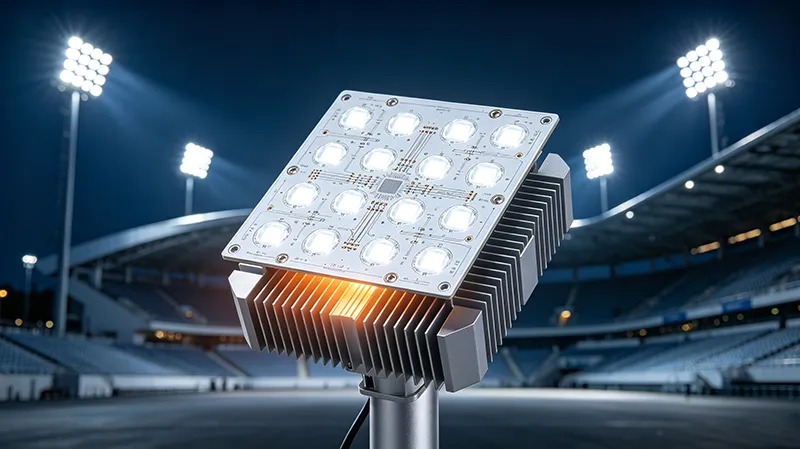
High-Power LED Lighting Places Greater Demands on PCB Thermal Management
High-power LED fixtures typically incorporate multiple LED light sources and generate considerable heat during extended operation. Since LED luminous efficiency and service life are closely related to operating temperature, efficient heat transfer and dissipation are important factors affecting the overall performance of the lighting system.
Aluminum PCBs are a commonly used type of metal core PCB (MCPCB) in LED lighting applications. Compared with conventional FR-4 PCBs, aluminum PCBs generally provide better thermal conductivity. A typical aluminum PCB consists primarily of a copper circuit layer, a thermally conductive dielectric layer, and an aluminum base layer. Heat generated by LED devices can be transferred through the copper circuit layer and thermally conductive dielectric layer to the aluminum base, and then further dissipated into the surrounding environment through a heat sink or the fixture structure.
The thermal performance of an aluminum PCB depends not only on the aluminum base but also on factors such as the thermal conductivity, thickness, and thermal resistance of the thermally conductive dielectric layer. Therefore, in high-power LED lighting applications, the PCB material and structural parameters should be selected according to the power density, insulation requirements, and overall thermal design of the LED module.
Proper aluminum PCB material selection and structural design can help improve heat transfer between LED devices and the heat dissipation system, reducing the impact of heat buildup on LED performance. As a result, aluminum PCBs are widely used in high-power LED modules, industrial lighting, road lighting, and other applications with demanding thermal management requirements.
How Aluminum PCBs Support the Long-Term Reliability of LED Lighting Systems
In high-power LED lighting applications, stable thermal management is an important factor in supporting long-term operation. Aluminum PCBs need to provide not only good thermal conductivity but also structural stability and electrical reliability under demanding operating conditions.
The thermally conductive dielectric layer is one of the key components affecting the thermal performance and insulation reliability of an aluminum PCB. When selecting materials, factors such as thermal conductivity, dielectric thickness, dielectric withstand capability, thermal resistance, and bonding reliability with the copper foil and aluminum base should be considered together, rather than focusing solely on higher thermal conductivity.
For outdoor and industrial lighting equipment, PCBs may be exposed to temperature variations, humidity, mechanical vibration, and other environmental factors during long-term operation. Therefore, appropriate selection of aluminum base materials and thermally conductive dielectric materials, together with careful control of dielectric thickness, lamination processes, and quality inspection, can help ensure the thermal performance, electrical insulation, and product consistency of aluminum PCBs.
Performance Requirements for Aluminum PCBs in Outdoor High-Power LED Lighting
Outdoor high-power LED lighting equipment may be exposed to day-night temperature variations, seasonal temperature changes, humidity, mechanical vibration, and other environmental conditions over extended periods. Therefore, in addition to good thermal conductivity, aluminum PCBs also need to provide reliable bonding between the thermally conductive dielectric layer and the metal base, electrical insulation, and stability under thermal cycling conditions.
For applications such as high-mast lighting, road lighting, port lighting, and stadium lighting, the selection of aluminum PCBs for high-power LEDs should take into account the power density of the LED module, copper thickness, board thickness, thermally conductive dielectric layer performance, dielectric withstand requirements, and the overall heat dissipation structure of the lighting fixture to meet the thermal management and long-term reliability requirements of different lighting equipment.
Advances in High-Power LEDs Place Greater Demands on Aluminum PCBs
As energy-efficient lighting, smart lighting, and high-power LED technologies continue to advance, performance requirements for PCBs used in LED equipment are also increasing. As LED modules move toward higher power density, more compact designs, and greater reliability, PCBs need to achieve a better balance among thermal conductivity, electrical insulation, dimensional stability, and long-term reliability.
For PCB manufacturers, this requires continuous improvement in material selection, circuit fabrication, lamination control, and quality inspection processes to meet the thermal performance, electrical reliability, and product consistency requirements of different LED lighting products.
As a professional PCB manufacturer, HoYoGo provides aluminum PCB and high-precision PCB manufacturing services for high-power LED lighting, industrial lighting, and other high-power electronic equipment. Based on customer design files and technical requirements, HoYoGo manufactures aluminum PCBs according to specified requirements for thermal performance, copper thickness, board thickness, dielectric layers, and surface finishes. By maintaining strict control over key manufacturing processes, we focus on electrical insulation, dimensional consistency, and manufacturing quality to provide reliable PCB manufacturing support for LED lighting products.


 English
 Français
 Deutsch
 Português
 Pусский
 中文
中文