Welcome to visit Hoyogo website, let's connect the world together!
Customer service hotline:+86 13723413985 or 400 058 2288
As demand for ocean exploration, subsea engineering, and underwater equipment maintenance continues to grow, underwater robots are increasingly being deployed in applications such as marine surveying, resource exploration, underwater infrastructure inspection, environmental monitoring, and offshore engineering maintenance. Compared with traditional manual underwater operations, underwater robots can operate in harsh deep-sea environments characterized by high pressure, low temperatures, seawater corrosion, and complex water currents. These demanding conditions place higher requirements on the stability, durability, and long-term reliability of their electronic systems.
As a critical interconnection component in electronic systems, PCBs are responsible for component mounting, electrical connections, signal transmission, and power distribution. Their manufacturing quality directly affects the performance and reliability of underwater robots' control, navigation, communication, and power systems. With stable material properties, advanced manufacturing processes, and excellent electrical performance, high-reliability PCBs provide essential support for the long-term and reliable operation of underwater robots in harsh environments.
As a professional high-reliability PCB manufacturer, HoYoGo specializes in manufacturing high-precision, HDI, multilayer, and high-speed PCBs. We provide advanced PCB manufacturing services for underwater robots and marine electronic equipment, ensuring high reliability, consistent quality, and long-term performance in demanding underwater environments.
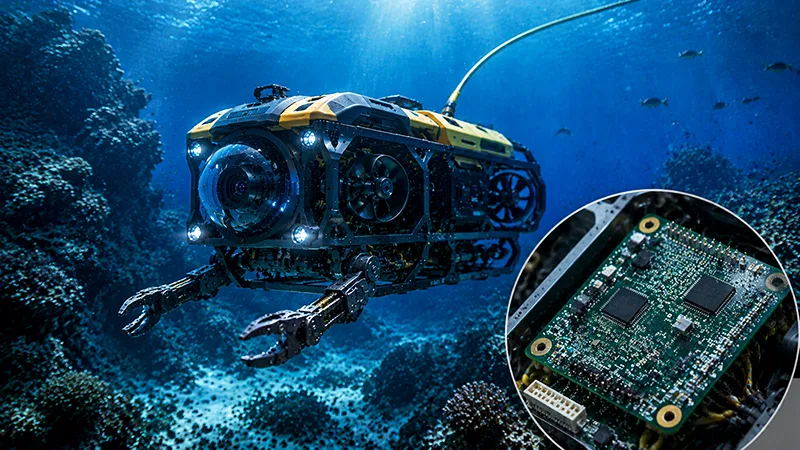
High-Reliability PCBs Enable Intelligent Sensing in Underwater Robots
Modern underwater robots integrate a wide range of electronic modules, including sonar systems, imaging devices, inertial navigation systems (INS), depth sensors, pressure sensors, and attitude sensors, enabling environmental perception, navigation, positioning, and data acquisition.
These sensing modules continuously collect and transmit large volumes of data, placing higher demands on PCB trace width accuracy, dimensional stability, electrical performance, and manufacturing consistency. Through precise circuit fabrication, reliable multilayer interconnections, and consistent manufacturing quality, high-reliability PCBs help ensure stable data communication among sensors, control units, and communication systems.
For underwater robots with high-speed data processing capabilities, PCBs must also provide excellent impedance control, low signal loss, and stable electrical performance. These characteristics help minimize signal attenuation and transmission interference, ensuring reliable high-speed data transmission in demanding underwater environments.
High-Reliability PCBs Enable Reliable Control and Communication Systems
During operation, underwater robots rely on their control systems to perform autonomous navigation, attitude adjustment, propulsion control, and mission execution, while communication modules enable data exchange with surface platforms or control terminals.
As underwater robots become more intelligent, data exchange among processors, sensors, communication modules, and power control units becomes increasingly complex, driving higher levels of electronic system integration. This requires PCBs to achieve higher wiring density, tighter manufacturing tolerances, and stable electrical performance.
Multilayer PCBs, high-density interconnect (HDI) PCBs, and high-speed PCB technologies can be tailored to meet the requirements of different underwater robotic applications. These advanced PCB technologies enable compact electronic systems, higher levels of integration, and reliable high-speed data transmission, improving overall system performance.
Ensuring Long-Term PCB Reliability in Harsh Underwater Environments
Underwater robots are typically required to operate continuously for extended periods, exposing their electronic systems to harsh conditions such as high humidity, seawater corrosion, high hydrostatic pressure, thermal cycling, and mechanical vibration.
To ensure long-term reliability, PCB manufacturing must focus on key factors including material reliability, interlayer adhesion strength, via reliability, copper thickness consistency, and solder joint reliability. The use of high-Tg materials and low-moisture-absorption laminates, combined with strict manufacturing process control, helps improve PCB stability in demanding underwater environments while reducing the risk of failures caused by thermal stress, moisture ingress, delamination, and interconnection issues.
For applications such as deep-sea exploration and subsea maintenance, where equipment servicing is costly and challenging, high-reliability PCBs help improve operational stability, minimize maintenance requirements, and extend equipment service life.
Electronic System Integration Drives the Evolution of PCB Manufacturing Capabilities
With the continuous advancement of autonomous control, artificial intelligence, and marine exploration technologies, underwater robots are evolving toward more compact designs, greater intelligence and autonomy, and higher levels of integration. Computing platforms, navigation modules, sensing systems, and communication devices must be integrated within limited space, placing more stringent requirements on PCB layer count, wiring density, material performance, and manufacturing precision.
Looking ahead, PCBs for underwater robots will continue to evolve toward higher circuit density, greater reliability, high-speed signal transmission, and lower signal loss. PCB manufacturers need to continuously enhance their material processing capabilities, precision manufacturing capabilities, and quality management systems to ensure consistent dimensional accuracy, circuit pattern quality, drilling accuracy, and electrical performance across different production batches.
High-Reliability PCBs Support the Growing Applications of Underwater Robots
As marine intelligent systems continue to advance, underwater robots are expected to play an increasingly important role in marine resource exploration, environmental monitoring, subsea communication maintenance, offshore wind farm maintenance, port inspection, and emergency rescue operations.
The diverse requirements of different application environments place higher demands on the reliability, communication capability, and data processing performance of electronic systems, driving PCB manufacturing toward greater precision and higher reliability. To meet these evolving requirements, PCB manufacturers need to continuously optimize material selection, manufacturing processes, and quality control systems, providing stable and reliable electronic interconnection support for underwater robots and other marine intelligent systems.
As a professional high-reliability PCB manufacturer, HoYoGo specializes in the production of high-precision, high-density, multilayer, and high-speed PCBs. We provide customized PCB manufacturing services tailored to the requirements of underwater robots, marine equipment, and intelligent control systems. By implementing production and quality control in accordance with IPC standards, HoYoGo delivers stable and reliable PCB manufacturing services for underwater robots and marine electronic systems.


 English
 Français
 Deutsch
 Português
 Pусский
 中文
中文