Welcome to visit Hoyogo website, let's connect the world together!
Customer service hotline:+86 13723413985 or 400 058 2288
As artificial intelligence (AI), high-performance computing (HPC), advanced process technologies, and advanced packaging continue to evolve, semiconductor manufacturing is placing increasingly stringent demands on process precision, production efficiency, and automation. Critical processes such as wafer fabrication, inspection and metrology, as well as semiconductor packaging and testing, increasingly rely on high-precision equipment for motion control, process monitoring, data acquisition, and high-speed data processing. These applications also impose more demanding requirements on the manufacturing precision, electrical performance, and long-term reliability of PCBs used in semiconductor equipment.
In semiconductor equipment, electronic control systems perform essential functions such as motion control, data acquisition, image processing, communications, and power management. As a critical platform for electrical interconnection and signal transmission between electronic modules, high-precision PCBs play an important role in maintaining the stable operation of equipment control systems. PCB manufacturing quality, electrical performance, dimensional stability, and long-term reliability can all directly affect overall system stability.
HoYoGo specializes in high-reliability PCB manufacturing, providing high-precision, multilayer, high-density, and high-speed PCB manufacturing services for semiconductor equipment, high-end industrial equipment, and precision electronic systems to meet the demanding PCB performance and reliability requirements of complex industrial applications.
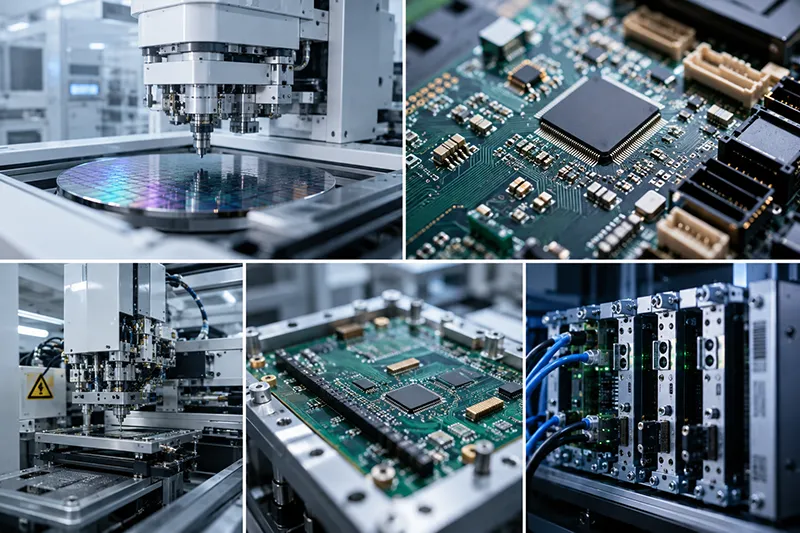
Higher PCB Manufacturing Requirements for Semiconductor Equipment
Semiconductor manufacturing equipment typically needs to operate reliably over extended periods in tightly controlled production environments while performing high-precision motion control, process control, and data acquisition tasks across wafer processing, inspection and metrology, and packaging and testing. As equipment functionality continues to expand and electronic systems become increasingly integrated, functions such as control, inspection, data processing, and communications place higher demands on PCB manufacturing precision, electrical performance, and long-term reliability.
In wafer fabrication and semiconductor inspection equipment, data such as temperature, pressure, position, and image data must be acquired and processed in real time through sensors and control modules. PCBs must not only provide reliable electrical interconnections between electronic modules but also support high-speed signal transmission and long-term operational reliability.
Therefore, PCBs used in semiconductor equipment require not only good dimensional stability and reliable interlayer interconnections, but also a high degree of consistency in multilayer alignment, hole positional accuracy, circuit pattern fabrication, impedance control, and material selection. These capabilities are essential to meeting the PCB manufacturing precision requirements of complex control systems and high-speed data transmission.
The Role of High-Precision PCBs in Semiconductor Equipment Control Systems
Semiconductor manufacturing involves multiple processes, including photolithography, etching, thin-film deposition, cleaning, inspection and metrology, as well as packaging and testing. Equipment used in these processes must perform tasks such as precision motion control, process monitoring, data acquisition, and data processing, placing stringent requirements on the stability and manufacturing precision of their internal electronic systems.
In this equipment, PCBs are widely used in control modules, motion control systems, inspection systems, data processing units, and communication modules, providing the foundation for signal transmission and electrical interconnections between different electronic modules. For high-precision multilayer PCBs, factors such as circuit pattern accuracy, layer-to-layer registration, drilling accuracy and hole positional accuracy, dielectric thickness, and dimensional changes after lamination can all affect final interconnection quality, electrical performance, and manufacturing consistency.
Strict control over critical PCB manufacturing processes, including pattern transfer, drilling, lamination, plating, and impedance control, can improve the fabrication accuracy of fine-line circuitry and interlayer interconnections while maintaining stable manufacturing consistency across production batches. For highly integrated semiconductor equipment, high-precision PCBs provide a reliable interconnection foundation for functional modules involving precision control, high-speed data acquisition, image processing, and communications, helping enhance the long-term operational stability of electronic systems.
High-Speed PCBs Meet the Data Transmission Requirements of Semiconductor Equipment
As semiconductor equipment becomes increasingly intelligent, machine vision inspection, precision sensing, and industrial control systems generate growing volumes of data, requiring fast and reliable data communication between different functional modules within the equipment.
By selecting suitable low-loss materials, controlling dielectric thickness and circuit geometry, and implementing strict impedance control and manufacturing process management, the effects of insertion loss and impedance discontinuities on high-speed signal transmission can be reduced, thereby improving signal integrity in high-speed interconnections. In applications such as industrial computing platforms, image processing modules, and high-speed communication units, high-performance PCBs can help enable more stable data transmission and meet the requirements of modern semiconductor equipment for real-time control and high-speed data processing.
High-Reliability PCBs Support the Long-Term Reliable Operation of Semiconductor Equipment
High-reliability PCBs used in semiconductor equipment are typically required to operate continuously for extended periods while being exposed to factors such as temperature variations, mechanical vibration, and thermal stress resulting from prolonged operation. Therefore, these PCBs require high levels of material reliability and manufacturing consistency.
Semiconductor equipment is generally designed for extended periods of continuous operation. During long-term operation, PCBs may be affected by temperature variations, localized thermal loads, mechanical vibration, and continuous electrical loads. Therefore, PCBs used in semiconductor equipment must not only maintain stable electrical performance but also meet long-term reliability requirements in areas such as material selection, interlayer interconnections, and manufacturing consistency.
By selecting appropriate PCB material systems, optimizing lamination processes, strengthening process control, and implementing rigorous quality inspection, high-reliability PCBs can achieve improved interlayer interconnection reliability, thermal reliability, and long-term operational stability. Consistent PCB quality helps reduce the risk of equipment issues caused by electrical interconnection failures or performance fluctuations, providing reliable support for the continuous operation of semiconductor equipment.
High-Reliability PCBs Support Semiconductor Equipment Automation and Industrial Communication
As semiconductor factories move toward greater automation and digitalization, the demand for inter-equipment data communication and system coordination continues to grow. Industrial communication technologies such as Industrial Ethernet, EtherCAT, and PROFINET are increasingly used in advanced manufacturing equipment, placing increasingly stringent demands on the signal transmission performance, manufacturing consistency, and reliability of high-precision PCBs.
PCBs with high manufacturing consistency can be used in industrial communication modules, equipment control systems, and data acquisition units, providing a reliable foundation for electrical interconnections in smart manufacturing systems and helping meet the demand for highly reliable electronic equipment in digital factories.
Advances in Semiconductor Equipment Drive Improvements in PCB Manufacturing Capabilities
The development of advanced process technologies, advanced packaging technologies, and smart manufacturing is driving semiconductor equipment toward higher precision, greater integration, and increased automation, while also advancing PCB manufacturing technologies.
Looking ahead, PCBs for semiconductor equipment will continue to evolve toward high-density interconnect (HDI), high-speed and low-loss performance, higher reliability, and greater manufacturing consistency. PCB manufacturers need to continuously strengthen their capabilities in material application, precision fabrication, and quality control to meet the growing demands of high-end equipment applications.
As a professional PCB manufacturer, HoYoGo has strong capabilities in high-reliability, high-precision, high-density, multilayer, and high-speed PCB manufacturing. Production and quality control are carried out in accordance with applicable IPC standards and customer technical requirements to meet the diverse PCB performance, precision, and reliability requirements of semiconductor equipment and high-end electronic applications.


 English
 Français
 Deutsch
 Português
 Pусский
 中文
中文