Welcome to visit Hoyogo website, let's connect the world together!
Customer service hotline:+86 13723413985 or 400 058 2288
AI training, inference, and high-performance computing require the processing of large volumes of data. Different types of AI accelerator cards may use GPUs, NPUs, or dedicated AI ASICs. AI accelerator cards typically include computing chips, power management circuits, and high-speed interfaces, while the way memory is integrated varies by product architecture. Providing high-speed signal paths and power connections within limited board space places greater demands on PCB circuit fabrication, impedance control, multilayer interconnections, and manufacturing consistency.
PCBs provide electrical interconnections and signal paths for components in AI accelerator cards. Different accelerator cards vary in computing architecture, interface type, board structure, and power requirements. As a result, PCB layer count, materials, trace dimensions, and interconnection structures may also differ. During manufacturing, materials, stack-ups, and key process parameters need to be controlled according to customer specifications.
HoYoGo is a professional AI accelerator card PCB manufacturer. Based on customer-specified materials, stack-ups, impedance targets, and interconnection requirements, HoYoGo manufactures PCBs for AI accelerator cards with different computing architectures and interface configurations.
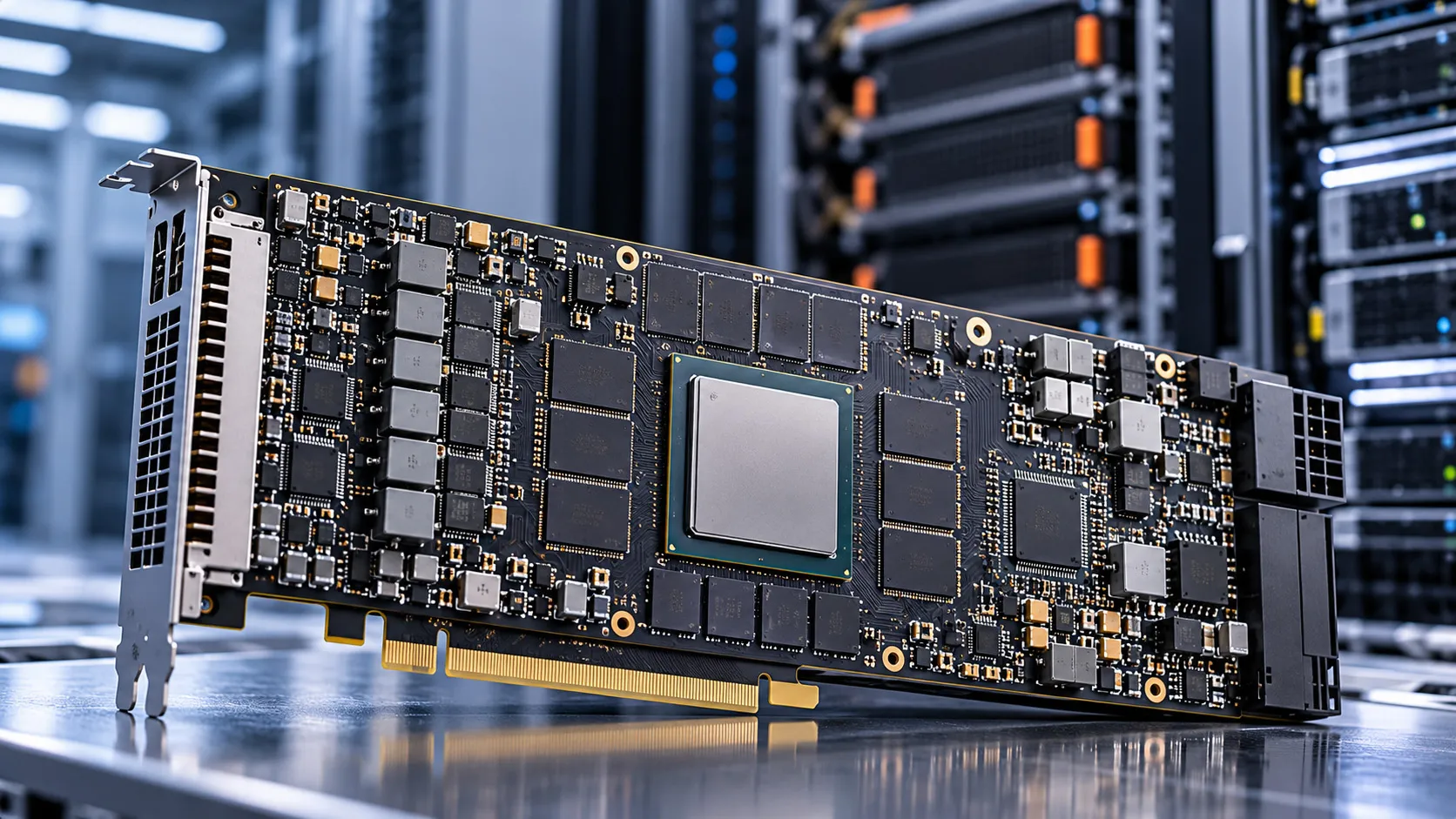
PCB Manufacturing Requirements for High-Speed Signal Transmission
AI accelerator cards require high-speed data transmission between computing chips and system interfaces through board-level signal paths. For high-speed signal traces or traces with specific impedance requirements, variations in trace dimensions, dielectric thickness, and copper thickness during PCB manufacturing may affect actual impedance and signal transmission performance.
During circuit fabrication, key parameters such as trace width, copper thickness, dielectric thickness, and etching consistency need to be controlled according to the stack-up structure and impedance requirements provided by the customer. For fine-line circuits, manufacturing consistency within individual boards and across different production batches also requires close attention to reduce the impact of process variations on trace dimensions and electrical performance.
Materials and Stack-Up Structures Affect High-Speed Performance
Some high-performance AI accelerator card PCBs use multilayer structures to support high-speed signal transmission and power connections across signal, power, and reference layers. The specific layer count and stack-up structure depend on interface speed, routing density, power requirements, and overall board design. For high-speed signal traces, parameters such as dielectric constant (Dk), dissipation factor (Df), and dielectric thickness can affect signal transmission and impedance control.
Depending on performance requirements, some high-speed AI accelerator cards may use low-loss materials to reduce dielectric losses during high-speed signal transmission. Manufacturing processes such as lamination, drilling, and circuit fabrication need to be controlled according to material characteristics and specific process requirements. Consistency between material batches, dielectric thickness, and finished board thickness should also be carefully monitored.
High-Density Interconnection Increases Manufacturing Complexity
Some high-performance AI accelerator cards have a high level of integration components, requiring computing chips, power management circuits, and interfaces to be accommodated within limited board space. As routing and interconnection density increase, multilayer PCB manufacturing becomes more demanding in areas such as layer-to-layer registration, lamination, drilling, and hole metallization.
Some high-density AI accelerator card PCBs may use HDI structures with microvias to improve board space utilization and interconnection density. For these PCBs, laser drilling quality, hole position accuracy, via metallization, and interlayer connection reliability require careful control. Significant deviations in critical manufacturing processes may affect electrical connections, subsequent component assembly, and long-term reliability.
High-Speed Interfaces and Impedance Consistency
AI accelerator cards exchange data with server motherboards and other system components through high-speed interfaces. Different products vary in interface type, transmission speed, and board structure, resulting in different PCB trace structures and impedance requirements.
For high-speed traces with controlled impedance requirements, production and impedance verification should follow the impedance targets, stack-up parameters, and test conditions specified by the customer. During volume manufacturing, inspection results and production records can be used to monitor impedance across boards and batches, identify process variations, and maintain impedance consistency.
PCB Reliability Under Thermal Loads
When AI accelerator cards operate under high workloads, computing chips, memory devices, and power modules generate heat. Although heat dissipation primarily depends on the thermal design of the system and board, PCB material properties and manufacturing quality also affect long-term reliability under elevated temperatures and thermal cycling conditions.
During PCB manufacturing, customer-specified materials, operating temperature, and reliability requirements should guide the control of key factors such as lamination quality, interlayer bonding, plated through-hole copper quality, and copper thickness. For products exposed to elevated temperatures for extended periods or repeated thermal cycling, attention should also be paid to material properties and manufacturing processes to reduce the risk of delamination and plated through-hole barrel cracking.
Consistency Control in Volume Manufacturing
For AI accelerator card PCBs, meeting dimensional and electrical requirements on an individual board is only the foundation. Maintaining manufacturing consistency across different boards and production batches is equally important. Because AI accelerator cards place demanding requirements on high-speed signal transmission, power connections, and component assembly, even small variations in manufacturing processes may affect product performance and assembly reliability.
During volume production, process control should cover raw material management, circuit fabrication, lamination, drilling, electroless copper deposition, electroplating, and final inspection. Appropriate inspection methods should be used to monitor key manufacturing parameters. Production parameters and quality records should also be maintained for traceability, allowing process variations to be identified and controlled in a timely manner. This helps reduce differences between individual boards and production batches and ensures that PCB products consistently meet customer technical requirements.
Development Trends of AI Accelerator Card PCBs
As AI computing chip performance and data transmission speeds continue to increase, AI accelerator cards are moving toward higher integration and greater data bandwidth, while board-level interconnection structures are becoming more complex. PCBs need to accommodate more high-speed signal traces, power distribution networks, and functional interconnections within limited space, placing greater demands on fine-line fabrication, multilayer interconnection, impedance control, and material processing capabilities.
AI accelerator cards vary in computing architecture, interfaces, power consumption, and board dimensions, so their PCB manufacturing requirements cannot be addressed with a single standardized approach. PCB manufacturers need to follow customer specifications for materials, stack-up structures, impedance, and reliability while maintaining strict control over key processes such as circuit fabrication, lamination, drilling, electroplating, and inspection.
HoYoGo is a professional AI accelerator card PCB manufacturer with capabilities in high-reliability, high-precision, multilayer, and high-speed PCB manufacturing. Following customer specifications and applicable IPC standards in production and quality control, HoYoGo provides reliable PCB manufacturing support for AI accelerator cards and related AI computing hardware, helping customers maintain consistent PCB quality from sample production through volume manufacturing.


 English
 Français
 Deutsch
 Português
 Pусский
 中文
中文