Welcome to visit Hoyogo website, let's connect the world together!
Customer service hotline:+86 13723413985 or 400 058 2288
Machine vision is widely used in smart manufacturing, automated inspection, robotics, logistics sorting, semiconductor manufacturing, and other fields. As an important component of machine vision systems, industrial cameras are responsible for capturing image data. Their image acquisition capabilities, data transmission efficiency, and operational stability can affect subsequent data processing and recognition performance.
Compared with conventional consumer cameras, industrial cameras are typically required to operate continuously for extended periods, support high-speed image acquisition, and adapt to different industrial environments. They integrate multiple functional modules, including image sensors, processors, memory devices, communication interfaces, and power circuits, placing higher demands on PCB high-speed signal transmission, manufacturing precision, dimensional stability, and long-term reliability. Some high-resolution, high-frame-rate industrial cameras also feature a high level of integration, making PCB thermal stability and long-term reliability important considerations during continuous operation.
HoYoGo is a professional industrial camera PCB manufacturer specializing in high-reliability, multilayer, high-precision, and high-speed PCBs, providing PCB manufacturing services for industrial cameras, machine vision equipment, and industrial automation applications.
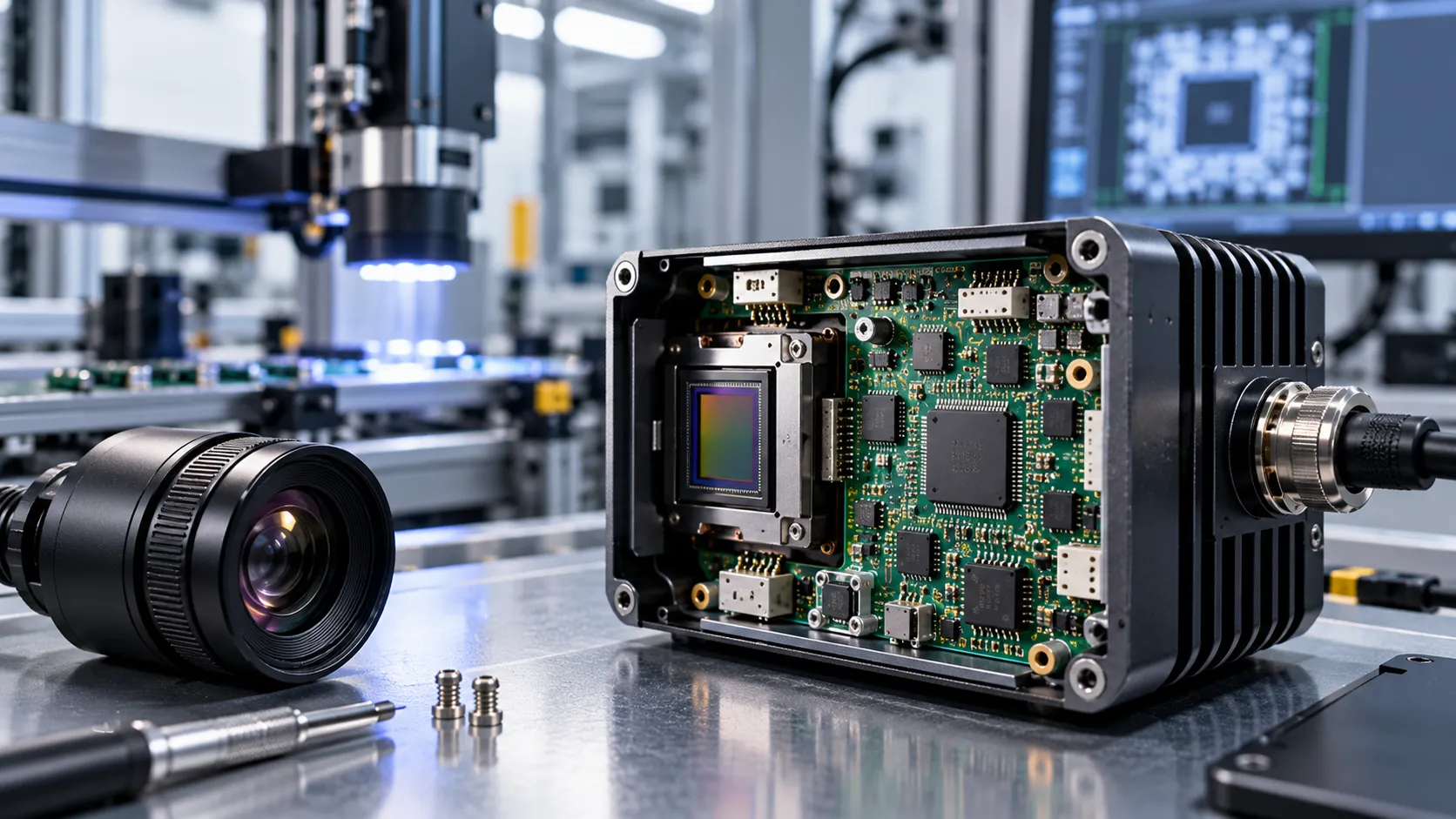
PCBs in Industrial Cameras
Industrial cameras typically consist of image sensors, image processing units, data transmission interfaces, power circuits, and control modules. PCBs provide component mounting, electrical connections, signal transmission, and power distribution, serving as an important platform for interconnecting these functional modules.
As industrial inspection applications demand higher image resolution and frame rates, the amount of image data that cameras need to capture and transmit continues to increase. At the same time, some industrial cameras are becoming more compact and highly integrated, requiring multiple electronic components and functional modules to be integrated within limited board space. This places higher demands on PCB circuit precision, interlayer interconnection, dimensional stability, and manufacturing consistency.
High-Speed Image Data Transmission
Image data captured by industrial cameras needs to be transmitted efficiently to back-end processing platforms. Some industrial cameras use interfaces or transmission standards such as GigE Vision, USB3 Vision, and CoaXPress. As image data transmission speeds increase, PCB circuit fabrication precision and impedance control have a greater impact on high-speed signal transmission performance. For interfaces using high-speed differential signaling, consistent trace dimensions and impedance control are particularly important.
From a PCB manufacturing perspective, parameters such as trace width and spacing, dielectric thickness, stack-up structure, and etching consistency need to be carefully controlled. For high-speed traces with impedance requirements, relevant manufacturing parameters should also be controlled according to the specified PCB materials and stack-up requirements to reduce the impact of production variations on impedance and signal transmission performance.
Manufacturing Challenges of High-Density Integration
As some industrial cameras become more compact and highly integrated, demand for multilayer PCBs and high-density interconnection structures is increasing. Connections between image sensors, processors, memory devices, interfaces, and other components need to be implemented within limited board space.
Higher routing and interconnection densities also increase manufacturing complexity in processes such as circuit fabrication, layer-to-layer registration, drilling, lamination, and hole-wall plating. For industrial camera PCBs using HDI structures, particular attention should be paid to microvia fabrication quality, microvia plating quality, and interlayer interconnection reliability. If critical processes such as layer registration, drilling, lamination, or hole-wall plating are not properly controlled, they may affect via interconnection reliability, electrical performance, and reliability after subsequent PCBA assembly.
Thermal Performance and Long-Term Reliability
During continuous image acquisition and processing, image sensors, processors, and power components generate heat. Some high-resolution, high-frame-rate industrial cameras have a high level of internal integration and operate continuously within compact spaces, making PCB stability under sustained thermal loads an important consideration.
During PCB manufacturing, appropriate materials should be selected according to the product's operating temperature and reliability requirements. Key factors such as copper thickness, lamination quality, hole-wall plating quality, and interlayer bonding also require careful control. Under prolonged thermal exposure or temperature variations, PCB material properties, lamination quality, and via interconnection reliability may affect long-term product stability. Material selection and manufacturing processes should therefore be controlled according to actual application conditions.
Reliability Requirements in Industrial Environments
Industrial cameras may be used on production lines, in automation equipment and robots, as well as in specialized industrial inspection environments. Actual operating conditions can vary considerably. Some applications may involve temperature variations, vibration, dust, and humidity, which can affect equipment stability during long-term operation.
These environmental factors involve not only system-level mechanical and protective design but also PCB materials and manufacturing quality. From a PCB manufacturing perspective, key factors such as material stability, plated hole quality, solder mask quality, and board surface cleanliness should be controlled according to customer product specifications and actual application conditions to meet reliability requirements across different industrial environments.
Volume Production and Manufacturing Consistency
For industrial camera PCBs, meeting performance requirements on an individual board is only the foundation. Maintaining manufacturing consistency across different production batches is equally important. Variations in PCB materials, board thickness, trace dimensions, dielectric thickness, hole structures, and surface finishes may affect subsequent PCBA assembly and electrical performance.
During production, critical processes and inspection items should be controlled according to product specifications. Key parameters such as trace dimensions, board thickness, dielectric thickness, and hole structures should remain within specified ranges to reduce manufacturing variations between batches and maintain stability and consistency throughout volume production.
Development Trends of Industrial Camera PCBs
As machine vision applications place increasing demands on image quality, acquisition speed, and data transmission capabilities, industrial cameras are becoming more compact and highly integrated while supporting higher-speed data transmission. Achieving high-speed signal transmission and interconnection between multiple functional modules within limited space places higher demands on PCB fine-line fabrication, multilayer interconnection, and manufacturing precision.
Industrial cameras vary in interface type, mechanical structure, and operating environment, resulting in different requirements for PCB materials, structures, and manufacturing processes. PCB manufacturing therefore needs to be tailored to specific product requirements, with consistent control over manufacturing precision, impedance, and batch-to-batch variation to meet the manufacturing requirements of different industrial camera products.
As a professional industrial camera PCB manufacturer, HoYoGo specializes in high-reliability, high-precision, multilayer, and high-speed PCB manufacturing. We provide customized PCB manufacturing services based on the specific requirements of industrial cameras, machine vision equipment, and industrial automation systems. Production and quality control are carried out in accordance with customer product specifications and applicable IPC standards to provide stable and reliable PCBs for industrial cameras and machine vision equipment.


 English
 Français
 Deutsch
 Português
 Pусский
 中文
中文