Welcome to visit Hoyogo website, let's connect the world together!
Customer service hotline:+86 13723413985 or 400 058 2288
Industrial drones are increasingly used in power inspection, smart agriculture, logistics, infrastructure inspection, emergency response, and other industrial applications. Compared with consumer drones mainly used for aerial photography and entertainment, industrial drones often operate in more demanding environments, with some systems required to perform frequent or extended missions. This places higher requirements on the environmental adaptability, operational stability, and long-term reliability of their internal electronic systems.
As a key component of industrial drone electronic systems, PCBs provide the foundation for component mounting, electrical interconnection, power distribution, and signal transmission. Flight control systems, communication modules, navigation units, sensor interfaces, and data processing modules all rely on PCBs for reliable electrical connections. PCB material performance, manufacturing precision, and production quality can directly affect electrical interconnection, mechanical reliability, and long-term operating stability. For this reason, high-reliability PCBs and consistent manufacturing processes are essential to the dependable operation of industrial drone electronic systems.
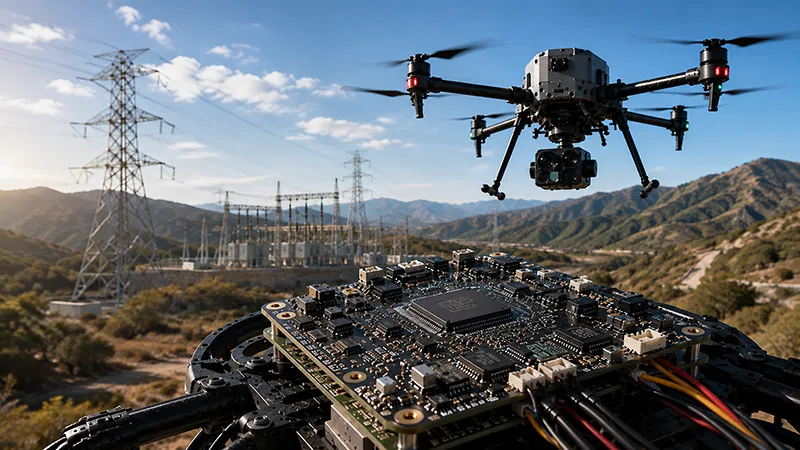
Industrial Drone Applications Place Higher Demands on PCB Reliability
Industrial drones are widely used in applications such as power line inspection, mining surveying and mapping, agricultural monitoring, infrastructure inspection, and firefighting and rescue operations. During operation, these systems may be exposed to a variety of demanding conditions.
Such conditions can affect PCB material performance, electrical connections, and mechanical stability. PCBs used in industrial drones therefore require stable electrical performance as well as appropriate mechanical, thermal, and environmental reliability. Factors such as material selection, lamination quality, drilling and hole-processing accuracy, plated copper quality, interlayer interconnection reliability, and surface finish can all affect long-term PCB reliability.
For high-reliability applications, strict process control and quality inspection are required throughout PCB manufacturing to maintain consistency in circuitry, hole structures, and interlayer connections, providing reliable electrical interconnections for industrial drone electronic systems.
High-Speed Signal Transmission Places Higher Demands on PCB Manufacturing
Modern industrial drones typically integrate high-definition imaging devices, multiple sensors, wireless communication modules, and data processing units to perform functions such as image acquisition, environmental sensing, data transmission, and mission control. As onboard computing and communication capabilities expand, some electronic systems need to process high-speed digital signals, placing greater demands on PCB signal transmission performance, manufacturing precision, and product consistency.
During high-speed signal transmission, factors such as material dielectric properties, circuit fabrication accuracy, impedance consistency, dielectric thickness, and layer-to-layer registration can affect PCB signal transmission performance. Stable control of materials, circuitry, dielectric thickness, impedance, and other critical factors is therefore required during manufacturing to minimize the impact of processing variations and maintain consistent impedance and key electrical characteristics across production batches.
For industrial drones equipped with high-performance computing and high-speed communication modules, high-speed PCBs can provide a stable foundation for high-speed signal transmission according to specific system requirements. As data rates and system complexity continue to increase, PCB manufacturing places greater demands on material application, impedance control, and process consistency.
Complex Environments Test Long-Term PCB Reliability
When industrial drones operate in outdoor environments, their PCBs may be exposed to temperature cycling, high temperature and humidity, mechanical vibration, shock, and thermal stress. In addition to material properties and manufacturing processes, appropriate quality inspections and reliability testing are needed to verify key PCB performance characteristics.
For high-reliability PCBs, particular attention should be paid to plated through-hole reliability, interlayer bonding, insulation performance, and structural stability under repeated thermal cycling. During manufacturing, inspection methods such as automated optical inspection (AOI), electrical testing, impedance testing, and cross-section analysis can be used to verify circuit quality, electrical continuity, impedance performance, plated hole quality, and interlayer structures.
Depending on application requirements, reliability evaluations such as thermal cycling, thermal shock, and damp heat testing can also be conducted to assess PCB performance under different environmental conditions. Combining manufacturing process control with appropriate quality and reliability verification helps reduce the potential impact of production variations and environmental stresses on long-term PCB reliability.
Higher Integration Drives the Use of Multilayer and HDI PCBs
As industrial drones evolve toward greater miniaturization, integration, and functionality, their onboard electronic systems need to integrate more computing, communication, sensing, and control modules within limited space, placing greater demands on PCB routing density, layer count, dimensional accuracy, and manufacturing capabilities.
As electronic functionality increases within limited space, multilayer and high-density interconnect (HDI) PCBs can provide greater routing and interconnection capacity through additional routing layers, finer circuitry, and higher-density interconnection structures. For certain high-density applications, microvias and laser drilling processes can also be used to achieve more compact interlayer interconnections.
Manufacturing these PCBs places higher demands on fine-line fabrication, layer-to-layer registration, drilling and microvia processing, lamination, and interlayer interconnection reliability. Stable manufacturing precision and process control help maintain the consistency and reliability of high-density PCBs in terms of dimensions, circuitry, and interconnection structures.
As the integration level of industrial drone electronic systems continues to increase, PCB manufacturers need to continuously improve their precision manufacturing, high-density interconnection, and process control capabilities to meet the integration and long-term reliability requirements of complex onboard electronic systems.
As a professional high-reliability PCB manufacturer, HoYoGo has manufacturing capabilities for high-precision, high-density, multilayer, and high-speed PCBs. Based on the application requirements of industrial drones, intelligent equipment, and automation systems, HoYoGo provides customized PCB manufacturing services with production and quality control conducted in accordance with applicable IPC standards and customer technical requirements.


 English
 Français
 Deutsch
 Português
 Pусский
 中文
中文