Welcome to visit Hoyogo website, let's connect the world together!
Customer service hotline:+86 13723413985 or 400 058 2288
With the continued development of industrial automation and flexible manufacturing, industrial robots are increasingly used in automotive manufacturing, electronics assembly, precision machining, and logistics handling. Industrial robot controller PCBs support coordinated multi-axis control and real-time industrial communication while meeting the electrical performance and long-term reliability requirements of industrial robot control systems.
Depending on the equipment architecture and functional requirements, industrial robot controllers use different types of industrial control PCBs to support main control, communication interfaces, I/O control, and power management functions. Some controllers also integrate servo drive units, whose power PCBs must meet stringent requirements for finished copper thickness, conductor cross-sectional dimensions, insulation performance, and thermal reliability, adding to the complexity of PCB manufacturing and quality control.
HoYoGo is a professional Industrial robot controller PCB Manufacturer, with manufacturing capabilities in high-reliability, high-precision, high-density, multilayer, and high-speed PCBs. To meet the structural and application requirements of different industrial robot controllers, HoYoGo focuses on circuit fabrication accuracy, interlayer interconnection quality, and product reliability, providing customized PCB manufacturing services in accordance with customer technical specifications.
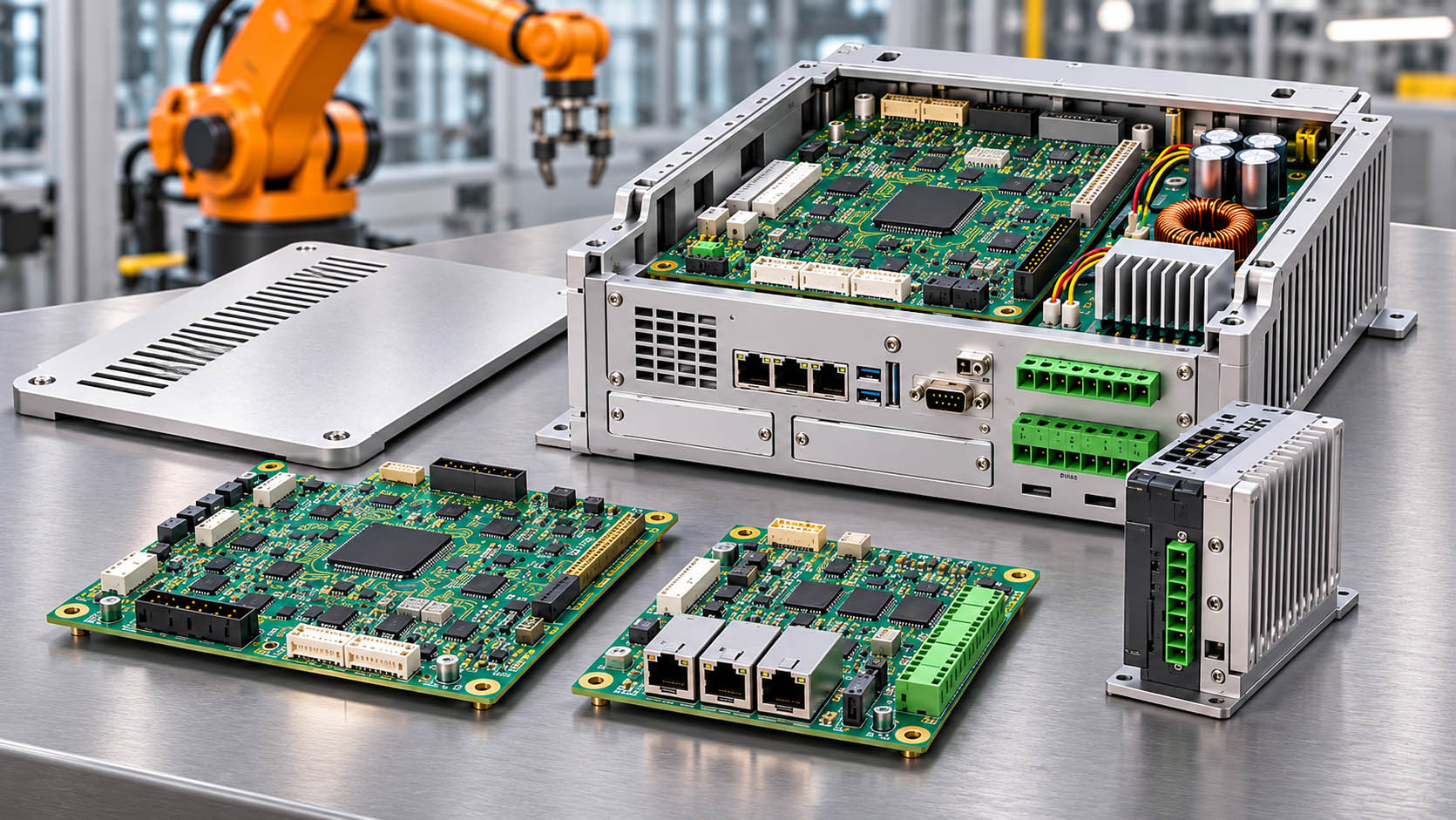
PCB Applications in Industrial Robot Controllers
Manufacturing requirements for the various PCBs used in industrial robot controllers differ according to circuit architecture and operating conditions. Main control boards typically feature multilayer structures and require high circuit fabrication accuracy, precise layer-to-layer registration, and reliable interconnections. For communication interface boards, trace dimensions and impedance variations must be controlled in accordance with product specifications, taking into account the interface type and data transmission rate, while paying particular attention to the stability of material dielectric properties.
In addition to meeting applicable insulation requirements, I/O control boards require accurate positioning of connector pads and mounting holes to meet assembly requirements. Manufacturing priorities for power supply boards include finished copper thickness, conductor cross-sectional dimensions, hole-wall copper plating quality, and substrate heat resistance.
Multilayer Interconnections and Circuit Fabrication Accuracy
As industrial robot controllers become increasingly integrated, some main control boards and communication interface boards require multilayer PCB structures to accommodate more complex circuit layouts and interlayer connections within limited board space. Certain products also incorporate high-density interconnect (HDI) technology. Fine traces, smaller pads, and complex interlayer interconnections make it increasingly challenging to maintain circuit fabrication accuracy and precise layer-to-layer registration.
High-precision PCB manufacturing also requires tight control over circuit dimensions and layer-to-layer registration tolerances to ensure that finished boards meet customer technical specifications.
During pattern transfer and etching, variations in trace width, trace spacing, and pad dimensions must be kept within specified tolerances. Multilayer lamination requires careful attention to dimensional changes in inner-layer cores and layer-to-layer registration accuracy. For products incorporating small-diameter through-holes or blind vias, drilling positional accuracy, hole-wall quality, and the thickness and uniformity of copper plating must also be controlled to ensure reliable interlayer electrical connections.
Industrial Communication and Impedance Control
Industrial communication technologies such as EtherCAT and PROFINET are widely used in robot control systems. For communication interface PCBs requiring controlled impedance, manufacturers must control relevant fabrication variations in accordance with customer technical specifications, taking into account the electrical characteristics of the interfaces involved.
During manufacturing, factors such as trace width, spacing between traces within a differential pair, copper thickness, dielectric thickness, and material dielectric constant all influence the characteristic impedance of transmission lines on the finished PCB. Consistency in dielectric properties across material batches must also be considered to improve impedance control stability. For products subject to stringent transmission loss requirements, materials with stable dielectric properties and suitable loss characteristics must be selected in accordance with technical specifications.
During finished board inspection, impedance testing may be performed on relevant traces in accordance with customer technical specifications to verify that the measured impedance falls within the specified tolerance range.
Current-Carrying Capacity and Insulation Reliability of Power PCBs
High-current power supply boards in industrial robot controllers and power PCBs used in integrated servo drive units place stringent demands on finished copper thickness, conductor cross-sectional dimensions, and hole-wall copper plating quality. These factors must be evaluated in conjunction with operating current, allowable temperature rise, and actual heat dissipation conditions to meet current-carrying capacity and interconnection reliability requirements.
The main manufacturing challenges associated with heavy copper PCBs arise during circuit etching, lamination, and solder mask processing. During etching, lateral undercut and variations in conductor cross-sectional dimensions must be carefully controlled. For multilayer heavy copper PCBs, particular attention must also be paid to resin filling between thick copper traces and interlayer bonding quality. In addition, surface height differences created by thick copper traces make solder mask application more challenging, requiring careful control of coating quality along trace edges and sidewalls.
For PCBs operating at higher voltages, conductor spacing on the finished board, dielectric thickness, and board surface cleanliness must also be controlled in accordance with customer technical specifications. Relevant performance tests, including insulation resistance and dielectric withstand voltage testing, must be conducted according to product acceptance requirements.
Long-Term Reliability in Industrial Operating Environments
Industrial robot controllers are typically required to operate continuously for extended periods. High-reliability PCBs used in these controllers must maintain stable performance during long-term operation. Heat generated within the equipment and frequent startup and shutdown cycles may expose PCBs to repeated temperature fluctuations. Depending on the controller's installation location and protective measures, PCBs may also be subject to mechanical vibration and humidity variations.
During thermal cycling, differences in thermal expansion between substrate materials and copper can subject plated hole walls and interlayer interconnections to repeated thermal stress. Manufacturers must therefore pay particular attention to substrate heat resistance, interlayer bonding quality, and the thickness and uniformity of hole-wall copper plating to reduce the risk of delamination, barrel cracking, and interlayer connection failures during long-term operation.
For PCBs used in humid operating environments, particular attention must also be paid to board surface cleanliness and the control of residual ionic contamination to reduce the risk of insulation degradation and electrochemical migration under applied voltage. In addition to routine electrical testing and dimensional inspection, relevant reliability tests, including thermal stress, thermal cycling, and insulation performance testing, may be conducted in accordance with customer technical specifications.
Evolving PCB Manufacturing Requirements for Industrial Robot Controllers
Industrial robot controllers are becoming more compact and highly integrated. As multi-axis control and communication functions become increasingly integrated, some PCBs must accommodate more complex circuit layouts and interlayer interconnections within limited space. In controllers incorporating servo drive units, power PCBs must also meet requirements for current-carrying capacity, insulation performance, and long-term operational reliability.
To accommodate the diverse manufacturing requirements of these PCBs, manufacturers need to strengthen process control in fine-line circuit fabrication, layer-to-layer registration, and the fabrication of complex interlayer interconnections. For heavy copper PCBs and products with stringent insulation requirements, process stability and consistency in volume production remain equally important manufacturing considerations.
As a professional industrial robot controller PCB manufacturer, HoYoGo specializes in high-reliability, high-precision, high-density, multilayer, and high-speed PCB manufacturing, providing customized PCB manufacturing services to meet the application requirements of industrial robot controllers and industrial automation equipment. Production and quality control are carried out in accordance with applicable IPC standards and customer technical specifications, with particular emphasis on manufacturing process stability, product reliability, and consistent product quality across delivered batches. These capabilities support the manufacture of reliable PCBs for industrial robot controllers and other industrial automation equipment.


 English
 Français
 Deutsch
 Português
 Pусский
 中文
