Welcome to visit Hoyogo website, let's connect the world together!
Customer service hotline:+86 13723413985 or 400 058 2288
As renewable energy, power infrastructure, communication systems, industrial control, transportation, environmental monitoring, and security applications continue to expand, more electronic equipment is being deployed outdoors for long-term operation. Compared with indoor applications, outdoor equipment may be exposed to temperature fluctuations, high humidity, condensation, dust, and mechanical vibration. In some regions, equipment may also be exposed to corrosive conditions such as salt spray. These environmental factors place greater demands on the ability of electronic systems to withstand harsh environments and maintain long-term reliability.
It should be noted that PCBs are typically installed inside the equipment. The actual environmental stresses they experience also depend on the enclosure protection level, internal thermal conditions, installation position, and PCBA-level protective measures such as conformal coating or potting.
As a key interconnection component in electronic equipment, a PCB provides electrical connections and signal transmission between electronic components. For equipment intended for long-term outdoor operation, PCBs need to meet basic electrical performance requirements while maintaining good environmental and structural reliability over extended periods of use. PCB manufacturing therefore needs to take actual operating conditions into account, with material selection, manufacturing processes, and quality control adapted to the requirements of each application.
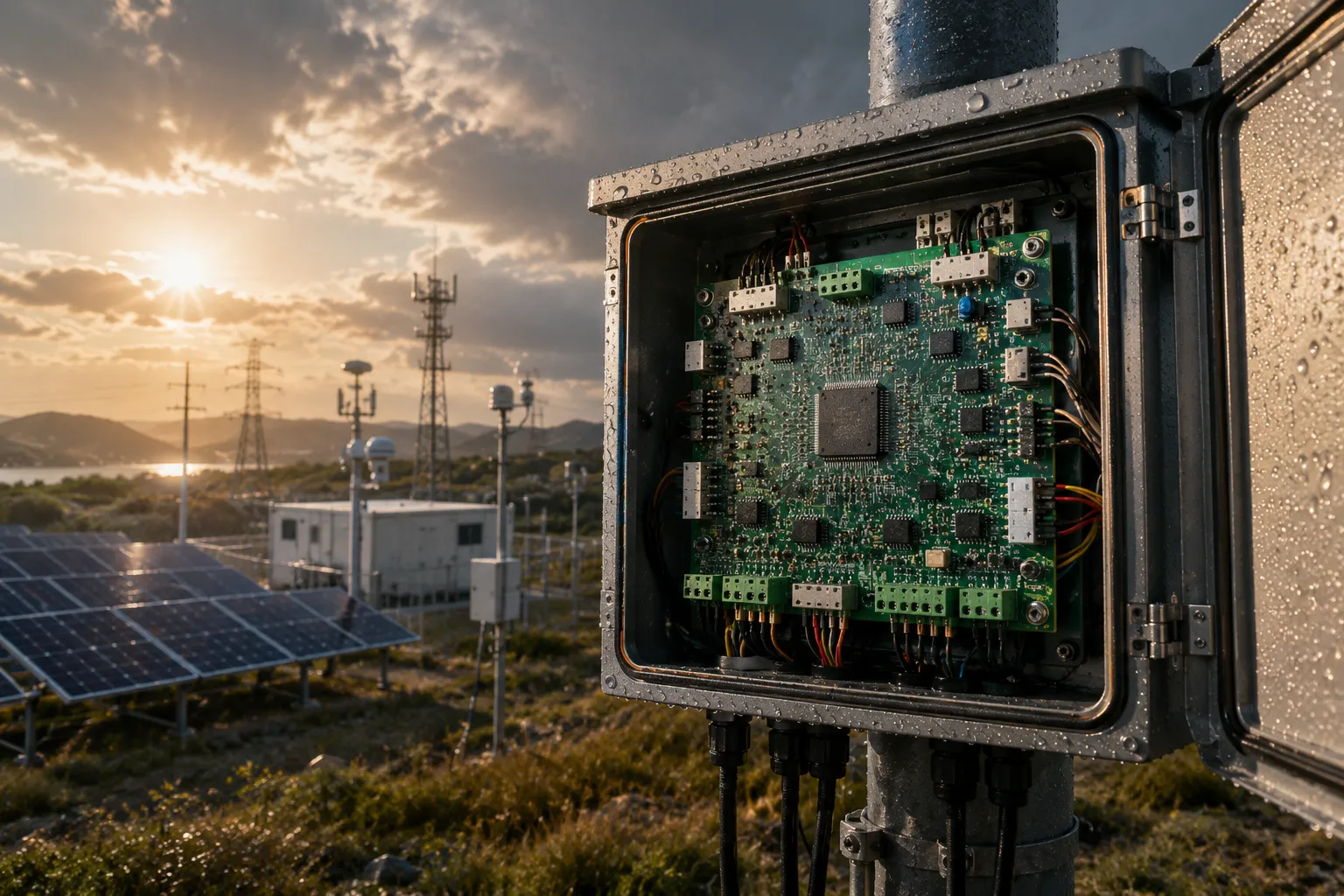
Impact of Temperature Changes on Long-Term PCB Reliability
Outdoor equipment is often exposed to daily and seasonal temperature fluctuations, while some applications may operate in high- or low-temperature environments for extended periods. Differences in thermal expansion between the materials used in a PCB can generate repeated thermal stress, which may affect internal interconnections and interlayer bonding over time.
From a PCB manufacturing perspective, the glass transition temperature (Tg), coefficient of thermal expansion (CTE), and thermal endurance of the base material, together with lamination quality, interlayer adhesion, hole-wall quality, and plated-through-hole reliability, can all affect PCB performance under long-term temperature cycling. For outdoor applications with higher reliability requirements, appropriate reliability testing can be carried out according to actual operating conditions to evaluate PCB stability under thermal cycling.
Challenges to Insulation Reliability in Humid and Condensing Environments
Equipment operating outdoors for extended periods may be exposed to high humidity and condensation. When moisture, dust, and environmental contaminants enter the equipment, they can increase the risk of PCB surface contamination, metal corrosion, and deterioration of insulation performance.
PCB manufacturing therefore needs to account for material moisture absorption, production environment control, and product cleanliness to minimize the impact of manufacturing residues on long-term reliability. For high-reliability applications, damp heat testing, insulation performance verification, or other relevant reliability evaluations may also be required according to the actual operating conditions and customer specifications to assess PCB reliability in high-humidity and condensing environments.
As electronic equipment becomes more highly integrated, some outdoor applications use PCBs with smaller conductor spacing and higher interconnection density. Under the combined effects of humidity, electrical bias, ionic contamination, and other factors, potential reliability risks such as conductive anodic filament (CAF) formation also need to be considered. CAF risk is influenced by the material system, manufacturing processes, and actual operating environment, making appropriate process and quality control important for these applications.
Salt Spray Environments Place Higher Demands on PCB Corrosion Resistance
Some outdoor equipment, such as coastal facilities, marine equipment, and certain energy systems, may operate for extended periods in environments with high salinity and humidity. Salt spray can accelerate corrosion of metallic materials and affect the long-term reliability of electronic systems.
For these applications, PCB manufacturing requires appropriate control over the material system, plating quality, solder mask integrity, surface finish, and ionic cleanliness based on the actual environmental requirements. PCB manufacturing quality should also be coordinated with PCBA-level protection, such as conformal coating or potting, as well as suitable enclosure sealing, to more effectively reduce the risk of corrosion caused by salt spray and moisture.
Salt spray testing is not required for every outdoor application. The need for such testing should be determined according to the installation location, expected service life, environmental conditions, and specific customer requirements.
Internal Interconnection Reliability Affects Long-Term PCB Performance
For outdoor equipment designed for long-term operation, reliable internal PCB interconnections are important to maintaining stable electronic system performance. Multilayer PCBs use internal circuitry and via interconnections to establish electrical connections between different layers, and the quality of these interconnections can affect long-term product reliability.
During PCB manufacturing, processes such as drilling, plating, lamination, and layer registration can all affect internal strict control of layer registration and plated-through-hole copperinterconnection quality. Stable manufacturing processes, together with strict control of layer registration and plated-through-hole copper quality, help reduce the risks of hole-wall defects, insufficient or uneven copper plating, layer misregistration, and interconnection failures caused by thermal stress.
For high-reliability products, PCB manufacturers typically use AOI, electrical testing, microsection analysis, plated-through-hole inspection, and applicable reliability testing according to the product structure and customer requirements.
Vibration Reliability Depends on Both the PCB and the Overall System
Equipment used in rail transportation, construction machinery, outdoor industrial systems, and energy applications may be exposed to mechanical vibration or shock over extended periods. Compared with conventional electronic equipment, these applications place higher demands on the stability of internal electronic components.
The structural reliability of the PCB affects its performance under vibration, but the vibration resistance of the equipment does not depend on PCB manufacturing alone. PCBA assembly quality, solder joint reliability, connector stability, mounting methods, and the mechanical structure of the complete system can also affect the equipment’s long-term operational reliability. Therefore, the PCB structure, PCBA assembly quality, connector reliability, mounting methods, and overall mechanical design should be evaluated together to ensure that the electronic system can meet long-term operating requirements.
Manufacturing Consistency Supports Long-Term Outdoor Reliability
Outdoor equipment designed for long-term operation typically has a long service life, making PCB consistency particularly important. In addition to ensuring that individual PCBs meet quality requirements, manufacturers need to maintain stable quality across different production batches.
From material management and inner-layer fabrication to lamination, plating, solder mask application, surface finishing, and final electrical testing, consistency throughout the PCB manufacturing process can affect long-term product reliability. A well-established quality management system and reliability control processes help reduce manufacturing variations and maintain consistent product quality across production batches.
Outdoor PCB Manufacturing Should Be Tailored to Actual Application Requirements
Different outdoor environments present different challenges. Equipment used in desert regions may be more affected by high temperatures and dust, while coastal equipment requires greater consideration of humidity and salt spray. Equipment operating in cold regions may face low temperatures and repeated temperature cycling, while vibration-prone applications require evaluation of PCB, PCBA assembly, and overall system reliability.
There is no single PCB manufacturing approach suitable for every outdoor application. Material systems, manufacturing processes, surface finishes, and reliability verification requirements should be selected according to the operating environment, expected service life, and customer specifications. For equipment intended for long-term outdoor operation, the manufacturing capability and quality control system of the PCB supplier are important factors in long-term product reliability.
As a professional high-reliability PCB manufacturer, HoYoGo specializes in high-precision, multilayer, and high-density PCB manufacturing. The company provides PCB manufacturing services for outdoor communication equipment, industrial control systems, energy equipment, smart devices, and other applications. Production and quality control are carried out in accordance with applicable IPC standards to meet the manufacturing and reliability requirements of electronic equipment intended for long-term outdoor operation.


 English
 Français
 Deutsch
 Português
 Pусский
 中文
中文