Welcome to visit Hoyogo website, let's connect the world together!
Customer service hotline:+86 13723413985 or 400 058 2288
With the growth of cloud computing, artificial intelligence, and data center operations, enterprise solid-state drives (SSDs) have become widely used in servers, high-performance computing platforms, and enterprise storage systems. Compared with consumer SSDs, enterprise SSDs are typically deployed in servers and data centers that require continuous operation, placing greater demands on performance stability, write endurance, data integrity, and long-term reliability. As PCIe interface speeds increase, storage capacities expand, and hardware integration levels rise, the associated PCBs face stricter requirements for fabrication precision, interconnection quality, and manufacturing consistency.
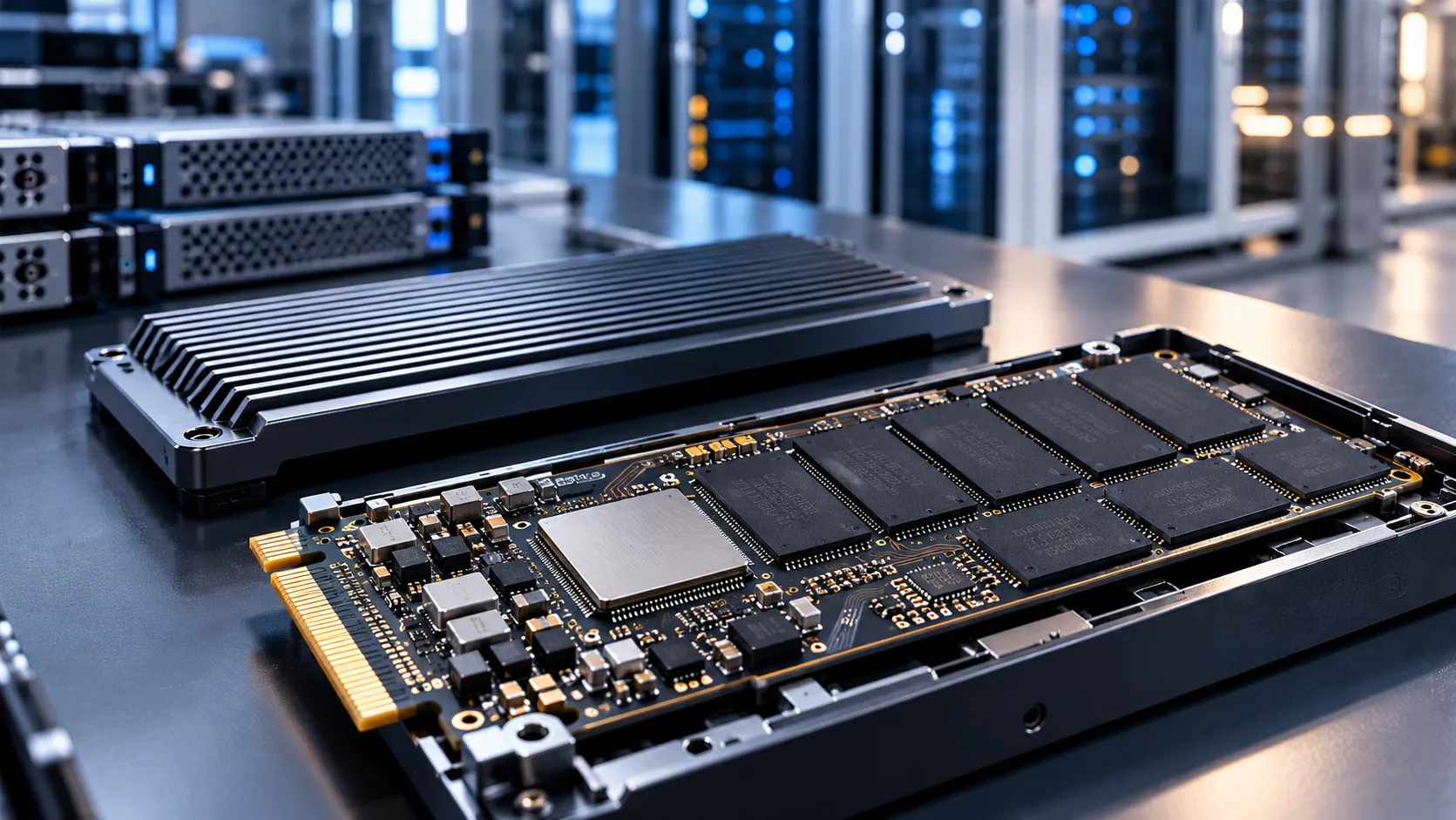
PCBs provide electrical connections, signal transmission paths, and power distribution among SSD controllers, NAND flash memory, optional DRAM cache, and power management components. They also provide the interface connections to the host system. Enterprise SSDs vary in interface type, storage capacity, and form factor, resulting in different PCB structures and manufacturing requirements. For products incorporating high-speed interfaces and densely packaged components, impedance control, fine-line fabrication, multilayer interconnection quality, and material thermal stability are key manufacturing considerations.
HoYoGo is a professional enterprise SSD PCB manufacturer specializing in high-reliability, high-precision, multilayer, and high-speed PCBs. For server, data center, and enterprise storage applications, we provide customized PCB manufacturing services based on customer product specifications and technical requirements, addressing the needs of circuit fabrication, interlayer connections, and quality consistency in volume production.
High-Speed Interfaces and Signal Transmission Requirements
Enterprise SSDs using PCIe interfaces and the NVMe protocol are widely deployed in server and data center storage systems. As PCIe technology advances and data transfer rates increase, the associated PCBs face stricter requirements for impedance control, transmission loss, and high-speed interconnection quality. Variations in trace dimensions, dielectric thickness, and material electrical properties can affect high-speed signal transmission.
During PCB manufacturing, trace width, finished copper thickness, dielectric thickness, and material dielectric constant (Dk) influence trace impedance and signal propagation characteristics. The dissipation factor (Df) is a key material parameter affecting dielectric loss, while conductor properties such as copper foil surface roughness influence conductor loss at high frequencies. PCB manufacturers must control circuit fabrication accuracy and dielectric thickness according to customer-specified stack-up structures, impedance requirements, and technical specifications. Impedance testing and applicable electrical performance tests are then conducted using specified methods to verify compliance with product requirements.
High-Density Memory Components and Multilayer Interconnections
Enterprise SSDs typically integrate an SSD controller, multiple NAND flash memory chips, and power management components. Some models also include dedicated DRAM cache. As NAND flash storage density increases and component packaging and configurations evolve, enterprise SSDs can employ different hardware architectures to meet capacity requirements. For products with limited board space and densely arranged components, PCB manufacturing must meet requirements for fine-line fabrication, pad dimensional accuracy, and multilayer interconnection quality.
Manufacturing these PCBs involves circuit fabrication, layer-to-layer registration, lamination, drilling, and hole metallization. Pad dimensions and positional accuracy affect alignment with component package terminals and the quality of subsequent component placement and soldering. Drilling accuracy and layer-to-layer registration determine how well drilled holes align with inner-layer pads, while the thickness, uniformity, and integrity of plated hole copper influence the long-term reliability of interlayer electrical connections. For products incorporating high-density interconnect (HDI) structures, microvia fabrication accuracy, layer registration, and lamination quality require additional control to ensure that the finished interconnections meet the specified technical requirements.
Thermal Reliability Under Sustained Read and Write Workloads
Enterprise SSDs are often required to operate for extended periods. Under sustained read and write workloads, particularly at high utilization levels, SSD controllers and power management components may generate significant heat. Where cooling is limited, temperatures in localized areas of the PCB may rise. Changes in operating load and ambient temperature can also expose the PCB to repeated thermal cycling.
Copper, resin, and reinforcement materials have different thermal expansion characteristics. Differences in thermal expansion during temperature changes can generate thermomechanical stress within the PCB structure, potentially affecting the long-term reliability of the board and its interlayer connections. PCB manufacturers must select suitable base materials according to customer-specified operating temperature ranges and reliability requirements, taking into account glass transition temperature (Tg), coefficient of thermal expansion (CTE), interlayer bonding, and hole metallization quality. Careful control of lamination and hole metallization processes helps reduce the risk of delamination and plated-through-hole barrel cracking under thermal cycling conditions.
Long-Term Reliability and Volume Manufacturing Consistency
Enterprise SSD PCBs vary in dimensions, layer count, circuit structures, and interconnection methods. PCB manufacturers therefore need to establish process controls suited to each product's requirements. For boards incorporating high-speed interfaces and multilayer interconnections, critical parameters include trace dimensions, dielectric thickness, layer-to-layer registration, and hole metallization quality. Controlling these parameters helps reduce manufacturing variation.
In volume production, effective raw material management and control of critical manufacturing processes are essential. Process monitoring helps identify abnormal variations in trace dimensions, layer registration, and hole metallization, supporting consistent quality across production batches. Dimensional inspection, electrical testing, and, where applicable, impedance testing and reliability verification should be conducted according to customer technical specifications to confirm that finished PCBs meet the required dimensional, electrical, and interconnection quality standards.
Development Trends in Enterprise SSD PCBs
As demand for AI servers, high-performance computing, and data center storage continues to grow, enterprise SSDs are evolving toward higher interface speeds, greater storage capacities, and increased hardware integration. Continued advances in PCIe technology are placing stricter demands on PCB impedance control, signal loss management, and high-speed interconnection quality. Meanwhile, the adoption of higher-capacity NAND flash memory and different SSD form factors is placing greater demands on fine-line fabrication, multilayer interconnections, and dimensional precision. Looking ahead, manufacturing precision, material performance, interconnection reliability, and consistency in volume production will remain key considerations in enterprise SSD PCB manufacturing.
HoYoGo is a professional enterprise SSD PCB manufacturer specializing in high-reliability, high-precision, multilayer, and high-speed PCB manufacturing. To address the requirements of enterprise SSDs for high-speed signal transmission, high-density interconnections, and long-term reliability, we provide customized PCB manufacturing services based on customer product specifications and technical requirements. We carry out production and quality control in accordance with applicable IPC standards and customer specifications, providing PCB manufacturing support for enterprise storage equipment and data center applications.


 English
 Français
 Deutsch
 Português
 Pусский
 中文
