Welcome to visit Hoyogo website, let's connect the world together!
Customer service hotline:+86 13723413985 or 400 058 2288
Artificial intelligence is increasingly being deployed in industrial production environments, with industrial AI inference equipment now used in machine vision inspection, industrial robotics, predictive maintenance, and intelligent production lines. These devices are typically installed on the factory floor or close to data sources, where local computing enables model inference and data processing with less dependence on remote computing resources. This approach helps meet industrial requirements for real-time response and on-site data processing. As inference workloads become more complex and hardware integration increases, PCBs play an increasingly important role in electrical interconnections, signal transmission, and operational reliability.
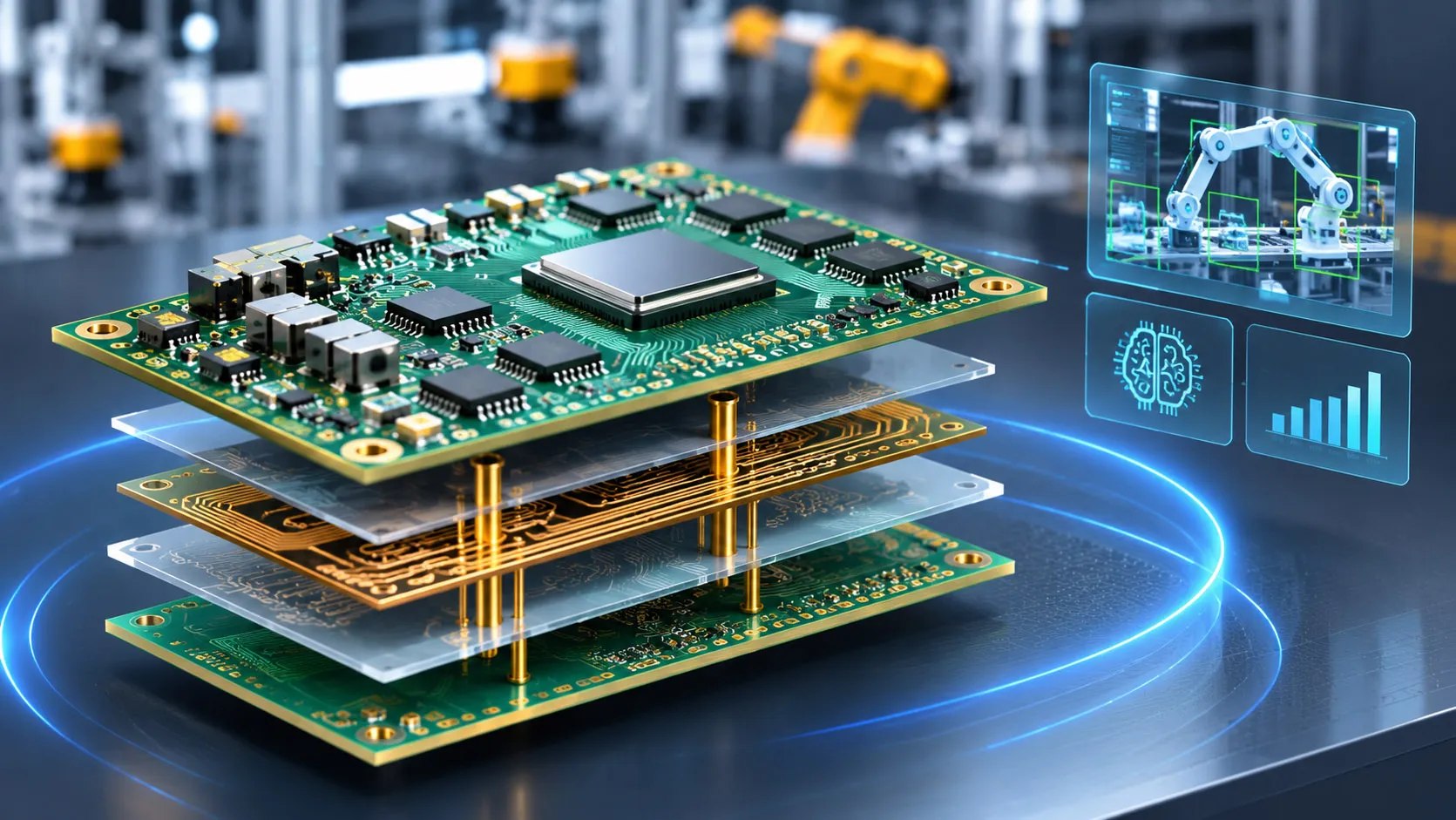
PCBs serve as essential electrical interconnection platforms in industrial AI inference equipment, supporting AI computing modules, memory modules, data acquisition units, communication interfaces, and power management modules. They provide electrical connections and signal paths between electronic components. Some devices must integrate high-performance processors and peripheral components within limited space while operating under industrial conditions involving temperature fluctuations and mechanical vibration. These requirements place greater demands on PCB fabrication precision, multilayer interconnection quality, and manufacturing consistency.
HoYoGo is a professional industrial AI inference equipment PCB manufacturer with expertise in manufacturing high-reliability and high-precision PCBs, including multilayer PCBs and high-speed PCBs. For industrial edge computing, machine vision inspection, and intelligent automation equipment, key PCB manufacturing considerations include circuit fabrication accuracy, impedance control, interlayer connection quality, material thermal properties, and consistency in volume production.
High-Speed Interconnections Between AI Processors and Memory
Industrial AI inference equipment typically uses CPUs, GPUs, NPUs, or dedicated AI accelerators to execute model inference tasks. During operation, these processors frequently access model parameters and intermediate computation data. In equipment incorporating high-performance processors or high-speed interfaces, data exchange between processors and memory, together with transmission through high-speed communication interfaces, places greater demands on PCB signal integrity and control of critical electrical parameters.
For PCBs incorporating high-speed digital interfaces, trace impedance, transmission loss, and dielectric material properties are important factors affecting signal integrity. Parameters such as trace width, finished copper thickness, dielectric thickness, and dielectric constant (Dk) influence actual impedance, while dissipation factor (Df), conductor loss, and transmission line geometry also affect signal transmission loss. PCB manufacturers must control circuit fabrication accuracy and dielectric thickness according to customer-specified stack-up structures, impedance requirements, and technical specifications. Impedance testing and applicable electrical performance tests are then performed as required to verify that the results meet the specified acceptance criteria.
High-Density PCB Manufacturing Requirements for AI Computing Modules
Industrial AI inference modules typically integrate processors, memory, power management ICs, and high-speed interface components. For processors using high-density packages and compact computing modules, PCBs must accommodate dense pad connections, fine-line circuitry, and multilayer interconnections within limited space. Fabrication precision and process stability are particularly important in these applications.
Manufacturing these PCBs involves fine-line fabrication, layer-to-layer registration, lamination, drilling, and hole metallization. Circuit and pad fabrication accuracy affects compatibility with high-density component packages during assembly. Drilling accuracy and layer registration influence the alignment of holes with inner-layer pads, while plated hole quality affects the long-term reliability of interlayer electrical connections. For products using high-density interconnect (HDI) structures, microvia fabrication, microvia metallization, and associated lamination processes must be controlled according to the specific board structure to ensure interconnection quality.
Thermal Reliability Under Sustained AI Inference Workloads
Industrial AI inference equipment often operates for extended periods, performing tasks such as image recognition, anomaly detection, and equipment condition analysis. Some high-performance processors have relatively high power densities. Under sustained heavy workloads and limited cooling conditions, temperatures around these processors may rise, exposing nearby PCB areas to increased thermal loads. Equipment startup and shutdown, changes in operating load, and fluctuations in ambient temperature can also cause repeated temperature changes. Differences in material thermal expansion characteristics may generate thermomechanical stress during thermal cycling, potentially affecting the long-term reliability of PCB materials and interlayer connections.
To address these operating conditions, PCB manufacturers must consider material glass transition temperature (Tg), coefficient of thermal expansion (CTE), and interlayer bonding properties in accordance with customer-specified temperature ranges and reliability requirements. Tg is an important indicator of substrate thermal properties but should not be interpreted as the PCB's maximum operating temperature. For plated-through-hole interconnections, the substrate's Z-axis thermal expansion characteristics must also be considered when evaluating thermal stress during temperature cycling.
During production, lamination quality and hole metallization processes require careful control to ensure that plated hole copper thickness and uniformity meet technical specifications. Material properties, board structure, and applicable reliability verification requirements must also be considered to reduce the risk of interlayer delamination, plated hole copper cracking, and other failures under thermal cycling conditions.
Industrial Deployment Conditions and PCB Reliability
Industrial AI inference equipment may be installed in industrial control cabinets or integrated into industrial cameras, robotic control units, and other edge computing terminals. Operating conditions vary depending on the installation environment. Fixed and mobile equipment may have different requirements concerning mechanical vibration, environmental exposure, and protective measures. PCB manufacturing quality and reliability verification must therefore be appropriate for the intended application.
In addition to routine dimensional inspection and electrical testing, PCB manufacturing may require attention to surface finish quality, board cleanliness, and other relevant quality indicators, depending on product requirements. Where specific environmental reliability requirements apply, appropriate reliability verification should be performed according to customer technical specifications. PCB manufacturing quality is one factor affecting the long-term stability of electronic hardware, while the overall environmental resilience of the equipment also depends on enclosure protection, cooling conditions, and assembly quality.
Volume Manufacturing and Quality Consistency
Some computing modules used in industrial AI inference equipment incorporate high-density processor packages, high-speed interfaces, and multilayer interconnection structures, making manufacturing consistency particularly important. Variations in trace dimensions, dielectric thickness, and critical process parameters between production batches may affect impedance consistency and interlayer connection quality. Volume production therefore requires not only compliance with product specifications but also effective process control to minimize quality variations between batches.
PCB manufacturers must maintain effective raw material management and control of critical manufacturing processes, with particular attention to the consistency of key dimensions, electrical performance, and process parameters across production batches. Dimensional inspection, electrical testing, and applicable impedance testing and reliability verification are performed according to customer technical specifications. Managing critical inspection results and process quality records also provides a basis for product traceability and batch-to-batch consistency.
Development Trends in PCBs for Industrial AI Inference Equipment
Demand for real-time data processing and local AI inference in industrial environments continues to grow. Related equipment is becoming increasingly diverse in processor configurations, data transmission requirements, and operating conditions. PCB manufacturers must align circuit fabrication, interconnection processes, and quality control with the technical specifications of individual products, ensuring that manufacturing processes and inspection procedures meet customer requirements.
HoYoGo is a professional industrial AI inference equipment PCB manufacturer specializing in high-reliability and high-precision PCB manufacturing, including multilayer PCBs and high-speed PCBs. To address the requirements of these applications for high-density interconnections, high-speed signal transmission, and long-term reliability, HoYoGo provides customized PCB manufacturing services based on customer product specifications and technical requirements. Production and quality control are carried out in accordance with applicable IPC standards and customer specifications, providing reliable PCB manufacturing support for industrial AI inference equipment and related industrial automation systems.


 English
 Français
 Deutsch
 Português
 Pусский
 中文
