Welcome to visit Hoyogo website, let's connect the world together!
Customer service hotline:+86 13723413985 or 400 058 2288
As speech recognition, natural language processing, and artificial intelligence technologies continue to advance, voice interaction is increasingly being integrated into smart speakers, smart home devices, AI toys, in-vehicle systems, and other smart devices. In addition to voice capture and playback, AI voice devices may support audio processing, data transmission, wireless communication, device control, and, in some products, local wake-word detection or on-device voice processing. As more functions are integrated into these devices, higher demands are placed on the connectivity, integration, and operational stability of their internal electronic systems.
As a key platform for electrical interconnection and signal transmission, the PCB connects processors, memory devices, microphones, audio processing units, wireless communication modules, power management circuits, and other functional components. When multiple functions are integrated within limited space, PCB manufacturing faces higher requirements for circuit fabrication, interlayer interconnection, hole processing, and consistency in volume production.
HoYoGo is a professional AI voice device PCB manufacturer specializing in high-reliability, multilayer, high-precision, and high-speed PCB manufacturing. We provide PCB manufacturing services for AI voice devices, smart home products, AI terminals, and other applications based on specific product requirements.
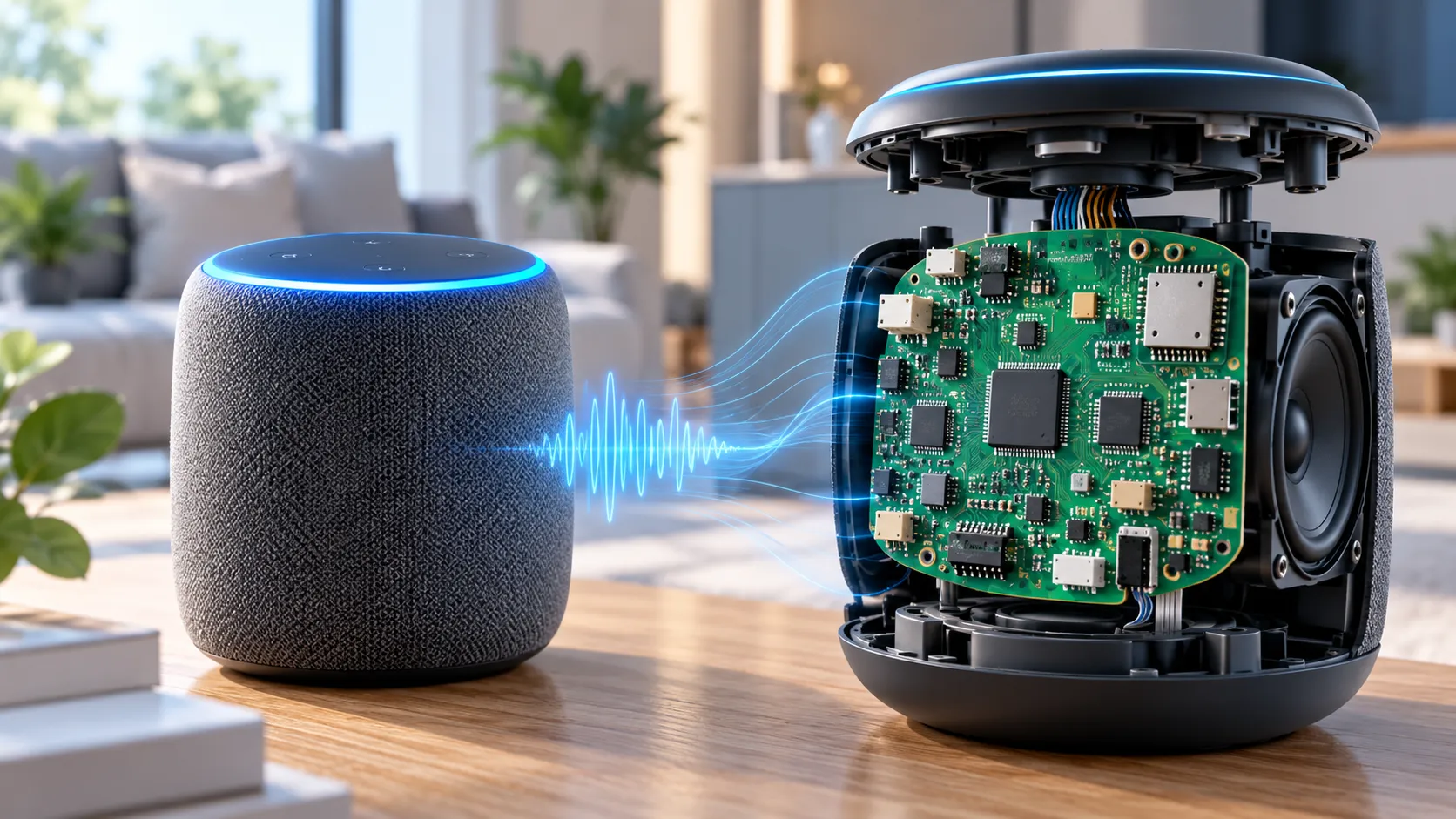
PCBs in AI Voice Devices
The hardware configuration of an AI voice device varies depending on its functions. Typical components may include processors, memory devices, microphones, audio processing units, wireless communication modules, power management circuits, and speaker-related circuitry. Some products use multiple MEMS microphones to form microphone arrays for multi-channel audio capture, combined with subsequent audio processing and speech recognition.
These functional modules need to transmit data, audio, and control signals while maintaining reliable electrical connections between different parts of the system. As more functions are integrated and product structures become increasingly compact, PCBs must accommodate more components and interconnections within limited board space. This places greater demands on circuit fabrication accuracy, interlayer connection quality, and manufacturing stability.
PCB Manufacturing Requirements for Audio and Digital Signals
Voice capture is an essential function of AI voice devices. Audio signals captured by microphones need to be transmitted to audio processing units or processors, while some devices need to handle multiple microphone channels simultaneously. Signal transmission stability depends primarily on system circuit design, but PCB manufacturing accuracy and consistency also play an important role. From a PCB manufacturing perspective, key factors such as circuit dimensions, etching uniformity, plated-through-hole interconnection quality, and interlayer connection reliability need to be controlled according to product specifications. This helps minimize the impact of manufacturing variations on electrical connectivity and signal transmission stability.
For high-speed digital signals or signal traces with specific impedance requirements, manufacturing parameters need to be controlled according to the specified PCB material, stack-up, dielectric thickness, circuit dimensions, and impedance requirements. During volume production, maintaining consistency in critical manufacturing parameters is also important for reducing the impact of process variations on electrical performance.
Manufacturing Challenges of High Integration
As more functions are incorporated into AI voice devices, processors, memory devices, audio components, wireless communication modules, and power management circuits need to be integrated within limited board space. To meet miniaturization and higher integration requirements, some products may use multilayer PCBs or high-density interconnect structures such as HDI, increasing the manufacturing complexity of circuit fabrication and interlayer connections.
As circuit and interconnect density increases, stable control of critical processes such as layer-to-layer registration, mechanical drilling, laser drilling, lamination, and copper plating of hole walls becomes increasingly important. For AI voice device PCBs using HDI structures, particular attention should be paid to microvia quality, hole-position accuracy, and interlayer interconnection reliability.
Significant variations in critical manufacturing processes may affect PCB electrical connectivity, subsequent component assembly, and long-term product reliability. Stable process control is therefore essential in the manufacturing of high-density PCBs.
Wireless Communication and Signal Transmission
Some AI voice devices connect to networks, mobile terminals, or other smart devices through wireless technologies such as Wi-Fi and Bluetooth. The PCB provides the electrical connections and signal transmission paths between wireless communication modules, processors, memory devices, and other functional modules.
For traces with specific impedance or RF performance requirements, PCB manufacturing needs to follow the specified material, stack-up, dielectric thickness, circuit dimensions, and impedance requirements while controlling other relevant manufacturing parameters. During volume production, consistency in critical dimensions and material parameters also needs to be maintained to minimize the impact of manufacturing variations on signal transmission performance.
Materials and Long-Term Reliability
Some AI voice devices are designed for long standby periods, continuous network connectivity, or frequent voice interaction. Processors, wireless communication modules, audio amplifiers, and certain power components generate heat during operation. For compact products, PCB material properties and long-term reliability are therefore important considerations during manufacturing.
PCB material selection should be evaluated according to the actual operating temperature, thermal cycling conditions, and reliability requirements of the product, with attention to key material properties such as glass transition temperature (Tg) and coefficient of thermal expansion (CTE). For products operating at higher temperatures or requiring long-term continuous operation, suitable PCB materials should be selected according to the specific application conditions.
During manufacturing, critical factors such as lamination quality, hole-wall copper plating quality, and interlayer bonding also need to be controlled to reduce the risk of reliability issues such as delamination and plated-hole cracking under prolonged thermal exposure or temperature cycling.
Volume Production and Manufacturing Consistency
When AI voice devices enter volume production, consistency between different PCB production batches becomes important. Significant variations in board thickness, circuit dimensions, dielectric thickness, hole structures, or surface finishes may affect subsequent component assembly and the electrical performance of the finished product.
Stable material management, process control, and quality inspection help reduce manufacturing variations between batches and improve PCB production consistency and stability.
Development Trends of PCBs for AI Voice Devices
As on-device AI processing capabilities continue to improve, voice interaction functions are also becoming more advanced. Some AI voice devices now incorporate greater local computing capability, audio processing, and wireless connectivity, resulting in increasingly integrated electronic systems. Accommodating more components and functional interconnections within limited space places higher demands on PCB fabrication accuracy, interconnect density, and manufacturing stability.
AI voice devices vary in product form, processing capability, audio systems, and wireless connectivity. Their requirements for PCB structures, materials, and manufacturing processes therefore also differ. PCB manufacturing needs to follow specific product specifications and maintain effective process control in areas such as precision circuit fabrication, multilayer and high-density interconnection, material control, and volume-production consistency.
HoYoGo is a professional AI voice device PCB manufacturer specializing in high-reliability, high-precision, and multilayer PCB manufacturing. We provide PCB manufacturing services for AI voice devices, smart speakers, smart home products, and other AI terminals based on specific application requirements. Our production and quality control processes strictly follow IPC standards to improve PCB manufacturing consistency and reliability.


 English
 Français
 Deutsch
 Português
 Pусский
 中文
中文