Welcome to visit Hoyogo website, let's connect the world together!
Customer service hotline:+86 13723413985 or 400 058 2288
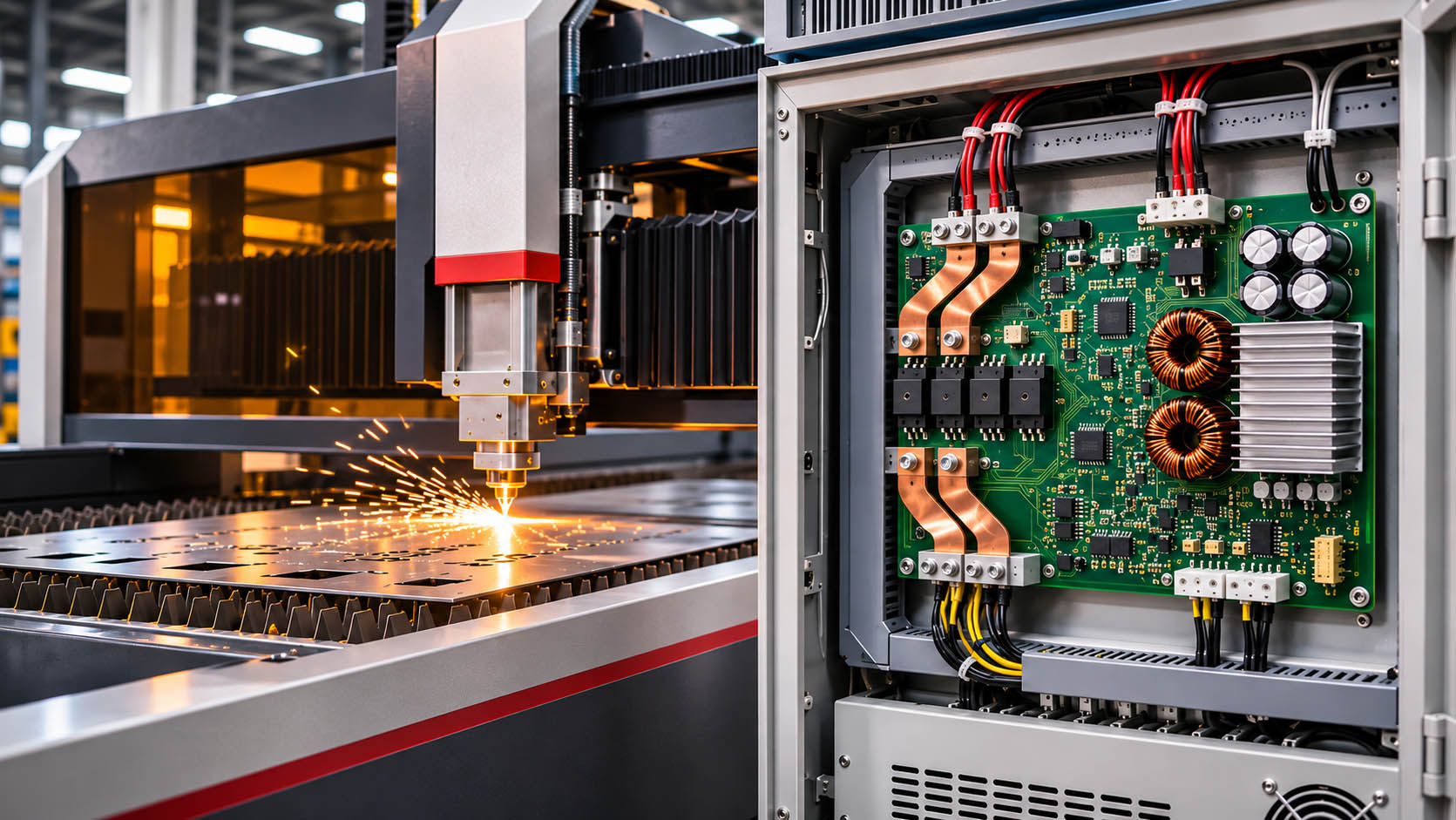
High-power industrial laser equipment is widely used in metal cutting, welding, surface treatment, and precision machining. As industrial production demands greater processing efficiency, precision, and equipment stability, the associated power management, laser power control, motion control, and condition monitoring systems face increasingly stringent requirements. As essential components of these electronic systems, PCBs play an important role in electrical interconnections, signal transmission, and stable equipment operation.
PCBs used in industrial laser equipment are primarily found in electronic units such as laser power supplies, power driver modules, control units, and sensor interfaces. They provide electrical interconnections, signal transmission, and power distribution. Some circuits must operate under high-current, high-voltage, and varying temperature conditions. Consequently, material properties, current-carrying capacity, insulation performance, and long-term reliability are important considerations in PCB manufacturing.
HoYoGo is a professional Industrial Laser Equipment PCB manufacturer, specializing in high-reliability, high-precision, multilayer, and high-speed PCB manufacturing. For PCBs used in high-power laser equipment, manufacturing requires particular attention to copper thickness control, material heat resistance, insulation performance, and precision circuit fabrication to meet the electrical and reliability requirements of different electronic units.
PCB Applications in High-Power Laser Equipment
High-power industrial laser equipment typically incorporates laser power supplies, control units, drive systems, cooling systems, and condition monitoring modules. These electronic units perform different functions and operate under different conditions, resulting in varying PCB manufacturing requirements.
PCB traces in laser power supplies and certain power driver modules must carry relatively high currents, placing stringent demands on finished copper thickness, trace cross-sectional area, and the reliability of high-current connection areas. Control and communication boards, by contrast, place greater emphasis on circuit fabrication accuracy, signal transmission quality, and stable interlayer connections.
PCB manufacturers must select suitable materials and manufacturing processes based on actual operating voltages, currents, temperature conditions, and customer technical specifications. This helps ensure that circuits serving different functions meet their respective electrical performance and reliability requirements.
Copper Thickness Control and High-Current Carrying Capacity
Some PCB traces in laser power supplies and power driver modules must carry relatively high currents. Insufficient finished copper thickness, inadequate trace cross-sectional area, or inconsistent connection quality can increase trace or connection resistance, raising the risk of localized heating.
For high-current PCBs, manufacturers must control finished copper thickness, trace width, and etching quality according to customer technical specifications. The current-carrying capacity of a PCB depends not only on copper thickness and trace width, but also on operating current, allowable temperature rise, and heat dissipation conditions. These factors must be evaluated together based on the specific application.
For thick copper PCBs, particular attention must also be paid to etching undercut, trace spacing, copper thickness uniformity, and overall etching quality. Thicker copper layers increase circuit fabrication challenges, making it important to control etching uniformity and trace width deviations. This helps ensure that the actual conductive cross-sectional area meets requirements and that fabrication variations do not compromise current-carrying capacity or electrical performance.
Thermal Management and Material Stability
Power supplies and driver modules in high-power laser equipment can generate substantial heat during operation, placing greater demands on the heat resistance and thermal cycling reliability of their PCBs.
During PCB manufacturing, key considerations include substrate heat resistance, glass transition temperature (Tg), decomposition temperature (Td), Z-axis coefficient of thermal expansion (Z-CTE), and interlayer bonding quality. For applications involving elevated operating temperatures or frequent temperature fluctuations, tighter lamination process control and careful management of plated-through-hole copper quality are essential. These measures help reduce the risk of barrel cracking and delamination caused by differential thermal expansion and thermal stress, improving the thermal cycling reliability of multilayer PCBs.
PCB substrate selection should also consider actual operating temperatures and thermal cycling conditions. Appropriate thermal properties and stable interlayer bonding help maintain structural integrity and reduce the risk of reliability issues during long-term operation.
Some power electronic modules may use metal-core PCBs. Their manufacture requires particular attention to dielectric layer thickness, insulation performance, and bonding quality between the metal substrate and dielectric layer. For applications with different power levels and heat dissipation requirements, PCB materials and board structures must be selected according to the actual product configuration and thermal management requirements to ensure an appropriate balance between heat dissipation and electrical insulation.
Insulation Performance and Electrical Reliability
Some power supply and power control circuits in industrial laser equipment operate at relatively high voltages, placing stringent requirements on PCB insulation performance and manufacturing quality.
PCB manufacturers must control electrical clearance, creepage distance, circuit fabrication accuracy, solder mask quality, and board cleanliness in accordance with customer technical specifications and the intended operating environment. Substrate insulation properties must also be considered. Electrical clearance and creepage distance should be determined based on operating voltage, insulation requirements, material properties, and the actual application environment, with specified requirements maintained during fabrication.
For applications exposed to high humidity or potential contamination, particular attention should be given to the tracking resistance of substrate materials and contamination control during manufacturing to reduce the risk of insulation degradation and electrical failure. Where specified, the Comparative Tracking Index (CTI) of substrate materials should also be considered.
Precision Circuit Fabrication and Multilayer Interconnection Quality
Control boards in industrial laser equipment typically incorporate processors and connect to sensors, communication interfaces, and driver units, requiring appropriate levels of PCB fabrication accuracy and interconnection quality.
Multilayer PCB manufacturing involves inner-layer circuit fabrication, lamination, drilling, and hole metallization. Poor layer-to-layer registration can cause misalignment between drilled holes and inner-layer pads, compromising interlayer connection quality. The thickness, uniformity, and integrity of plated copper on hole walls are also critical to reliable interlayer connections.
For boards requiring high-speed communication or controlled impedance, manufacturers must control trace dimensions and dielectric thickness according to customer technical specifications, while considering material dielectric properties. Trace geometry and impedance parameters must be managed together to meet the applicable signal transmission and impedance control requirements.
Manufacturing Reliability Under Long-Term Operating Conditions
Industrial laser equipment often operates continuously for extended periods. Some systems also undergo frequent start-stop cycles and may be exposed to vibration, dust, and changes in ambient temperature.
Reliable PCB manufacturing requires effective raw material batch management, stable critical manufacturing processes, and thorough finished board inspection. For products with stringent environmental reliability requirements, appropriate inspections and reliability verification must be conducted according to customer technical specifications. Particular attention should be given to thermal cycling performance, interlayer interconnection reliability, and electrical stability to reduce the risk of premature failures caused by manufacturing defects.
In addition, equipment structural design, PCB mounting and securing methods, and external protection measures can also affect PCB reliability under actual operating conditions. PCB manufacturing quality should therefore be evaluated in conjunction with the customer's overall equipment design and operating environment requirements.
Development of High-Power Industrial Laser Equipment and PCB Manufacturing Requirements
As industrial laser processing advances toward higher efficiency, greater precision, and increased automation, the associated electronic systems place greater demands on PCB current-carrying capacity, thermal stability, insulation performance, and manufacturing consistency.
Different types of laser equipment vary in power ratings, operating environments, and control systems, resulting in different requirements for PCB material properties and manufacturing processes. For PCB manufacturers, aligning production with specific application conditions and customer technical specifications, while maintaining stable critical processes and consistent finished board quality, is essential to meeting these diverse requirements.
As a professional manufacturer of Industrial Laser Equipment PCBs, HoYoGo provides customized PCB manufacturing services based on the application requirements of laser power supplies, power driver modules, and industrial control equipment. Production and quality control are carried out in accordance with applicable IPC standards and customer technical specifications, with particular attention to copper thickness uniformity, hole metallization quality, insulation performance, and consistency in volume production. These capabilities enable HoYoGo to provide PCB manufacturing support for power supply, drive, and control systems used in high-power industrial laser equipment.


 English
 Français
 Deutsch
 Português
 Pусский
 中文
