Welcome to visit Hoyogo website, let's connect the world together!
Customer service hotline:+86 13723413985 or 400 058 2288
As global photovoltaic (PV) installations continue to expand, the efficiency of PV power plant operation and maintenance is becoming increasingly important. PV modules remain exposed to outdoor environments for extended periods, allowing dust, sand, and other contaminants to accumulate on their surfaces. The accumulated dust can reduce the effective solar irradiance received by the PV modules, thereby lowering their power generation efficiency. Compared with conventional manual cleaning, PV cleaning robots can perform automated cleaning based on preset routes or sensor feedback. Many systems are also incorporating environmental sensing, status monitoring, and wireless communication to support more automated operation and maintenance of PV power plants.
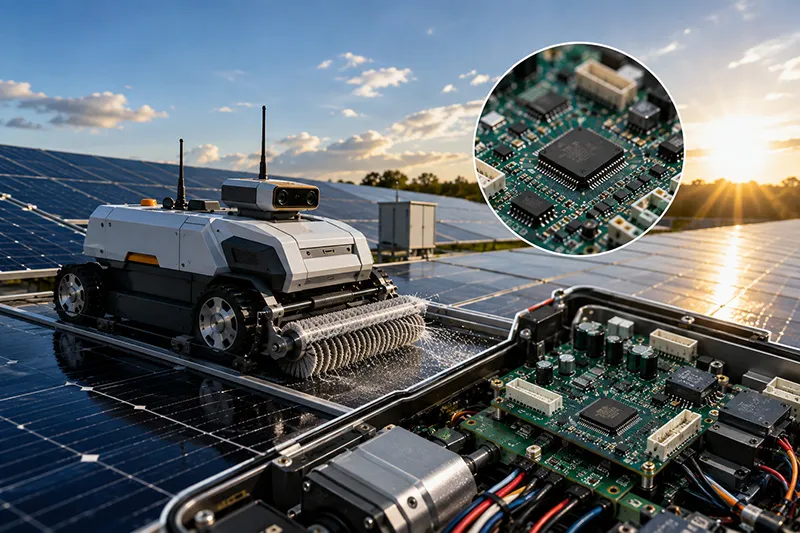
PV cleaning robots typically integrate controllers, motor drives, power management systems, and communication modules. Depending on the product configuration, they may also incorporate edge-detection sensors, encoders, inertial measurement units (IMUs), cameras, and other sensing devices. PCBs provide the electrical interconnections, power distribution, and signal paths required by these electronic modules. Manufacturing quality and consistency are important to the long-term operation of control, drive, and sensing systems. As more functions are integrated into the robot, PCB manufacturing must also meet higher demands for fabrication accuracy, via quality, dimensional control, and long-term reliability.
HoYoGo is a professional PCB manufacturer specializing in high-reliability, multilayer, and high-precision PCBs. We provide PCB manufacturing services for PV cleaning robots, industrial automation systems, and other intelligent equipment based on specific application requirements.
PCBs Support Motion Control and Cleaning Operations
Motion control is an important part of PV cleaning robot operation. These robots typically drive travel motors, roller brushes, or other cleaning mechanisms while adjusting their operating status based on feedback from encoders, edge-detection sensors, and other devices. Stable electrical connections between controllers, motor drivers, sensors, and related interfaces are essential for movement, cleaning, and operational control.
PCBs provide electrical interconnections for controllers, motor drivers, encoders, and related interfaces while accommodating the operating conditions of different control and drive circuits. For motor drive and power-related modules, important considerations include copper thickness, current-carrying capacity, temperature rise, and reliable connections to power components. Control and sensing modules, meanwhile, require appropriate circuit fabrication accuracy, via quality, and interface reliability based on the characteristics of the circuits involved.
PCBs Support Reliable Sensor and Communication Module Operation
During operation, PV cleaning robots rely on edge-detection sensors, encoders, IMUs, and other sensing devices to obtain position and operating status information. Some advanced systems may also incorporate cameras, ultrasonic sensors, or LiDAR for obstacle detection, environmental sensing, and autonomous navigation.
Data generated by these sensors is transmitted through interface circuits to controllers or other processing modules. PCBs provide the electrical connections between sensors, controllers, communication devices, and related interfaces. Circuit fabrication quality, via quality, surface finish consistency, and the quality of interface areas all contribute to stable electrical connections during long-term operation.
For robots equipped with wireless communication functions, the PCB must meet the electrical performance requirements of the relevant communication circuits and operating frequency bands. For interfaces carrying high-speed or high-frequency signals, impedance control and signal integrity may need to be managed according to specific circuit design requirements, while EMC should be considered as part of the overall system design. During manufacturing, consistent control of circuit fabrication, via quality, surface finishing, and final inspection helps maintain reliable operation of communication modules over time.
PCBs Meet Power and Motor Drive Requirements
PV cleaning robots are typically powered by batteries or other power systems. Depending on the product configuration, some may also incorporate solar charging or supplementary energy systems. Since controllers, sensors, communication modules, and drive motors have different power requirements, the robot generally requires corresponding power management and drive circuits.
Motor startup, acceleration, and cleaning mechanism operation may generate relatively high transient currents. PCBs used in power and motor drive modules therefore need to account for copper thickness, current-carrying capacity, temperature rise, and the reliability of power-component connection areas under actual operating conditions. For higher-current circuits, copper thickness, conductor width, and the current-carrying capacity of plated vias should be appropriately matched to support reliable power delivery and long-term operation.
Outdoor Environments Place Higher Reliability Demands on PCBs
Compared with indoor robots, PV cleaning robots mainly operate in outdoor PV power plants, where they may be exposed to temperature variations, moisture, dust, mechanical vibration, and extended periods of continuous operation. Some systems are deployed in challenging locations such as desert or mountainous PV installations, where on-site maintenance can be difficult. Long-term stability of the electronic system is therefore particularly important.
Temperature variations can generate thermal stress within the PCB due to differences in thermal expansion among its constituent materials, while prolonged mechanical vibration may increase reliability risks at solder joints and via interconnections. However, the PCB alone does not provide complete environmental protection for the equipment. Enclosures, sealing structures, connectors, and other protective measures must work together to address temperature variations, humidity, condensation, dust, and mechanical vibration. Consistent PCB manufacturing quality, together with appropriate system-level protection, helps support reliable long-term operation in outdoor environments.
Smarter PV Cleaning Robots Place Higher Demands on PCB Manufacturing
As PV power plants move toward digital and automated operation and maintenance, PV cleaning robots are incorporating functions such as status monitoring, autonomous navigation, and remote communication. Some advanced systems can transmit operating data to remote monitoring platforms through wireless communication, receive remote control commands where supported by the system configuration, and exchange data with PV plant operation and maintenance platforms.
As functionality expands, the number and integration level of electronic modules within the robot also increase. For robots produced in volume, PCB manufacturing consistency becomes particularly important. Manufacturers need to maintain stable process control across material selection, circuit fabrication, interconnect quality, surface finishing, and final inspection, taking into account the equipment's operating environment, power conditions, and functional requirements. This helps maintain consistent PCB quality from batch to batch.
As a professional PCB manufacturer, HoYoGo specializes in high-reliability, multilayer, and high-precision PCB manufacturing. We provide customized PCB manufacturing services based on the specific requirements of PV cleaning robots, industrial robots, and intelligent automation equipment. Through strict process control and quality inspection, HoYoGo focuses on electrical performance, interconnect reliability, and manufacturing consistency, providing reliable PCB manufacturing support for the long-term operation of intelligent equipment.


 English
 Français
 Deutsch
 Português
 Pусский
 中文
中文