Welcome to visit Hoyogo website, let's connect the world together!
Customer service hotline:+86 13723413985 or 400 058 2288
With the continued development of the Industrial Internet, artificial intelligence, machine vision, and the Internet of Things (IoT), an increasing number of data processing tasks are shifting from centralized cloud platforms to local devices and the network edge. By deploying computing resources closer to data sources, edge computing reduces the network burden caused by frequent data transmission to and from the cloud and better meets the real-time processing requirements of applications such as industrial control, machine vision, intelligent transportation, energy management, and smart retail.
Edge computing devices typically integrate processors, memory, network communication, data acquisition, and multiple interface modules. Some high-performance devices are also equipped with GPUs, AI accelerators, and other computing components. As computing performance and system integration continue to increase, PCBs need to support more complex electrical connections, high-speed signal transmission, and interconnections between multiple functional modules. This places higher requirements on PCB manufacturing precision, interlayer connection reliability, material compatibility, and long-term reliability.
HoYoGo is a professional PCB manufacturer specializing in high-reliability, multilayer, high-precision, and high-speed PCB manufacturing. We provide customized PCB manufacturing services based on the specific requirements of edge computing devices, industrial control systems, smart terminals, and other applications.
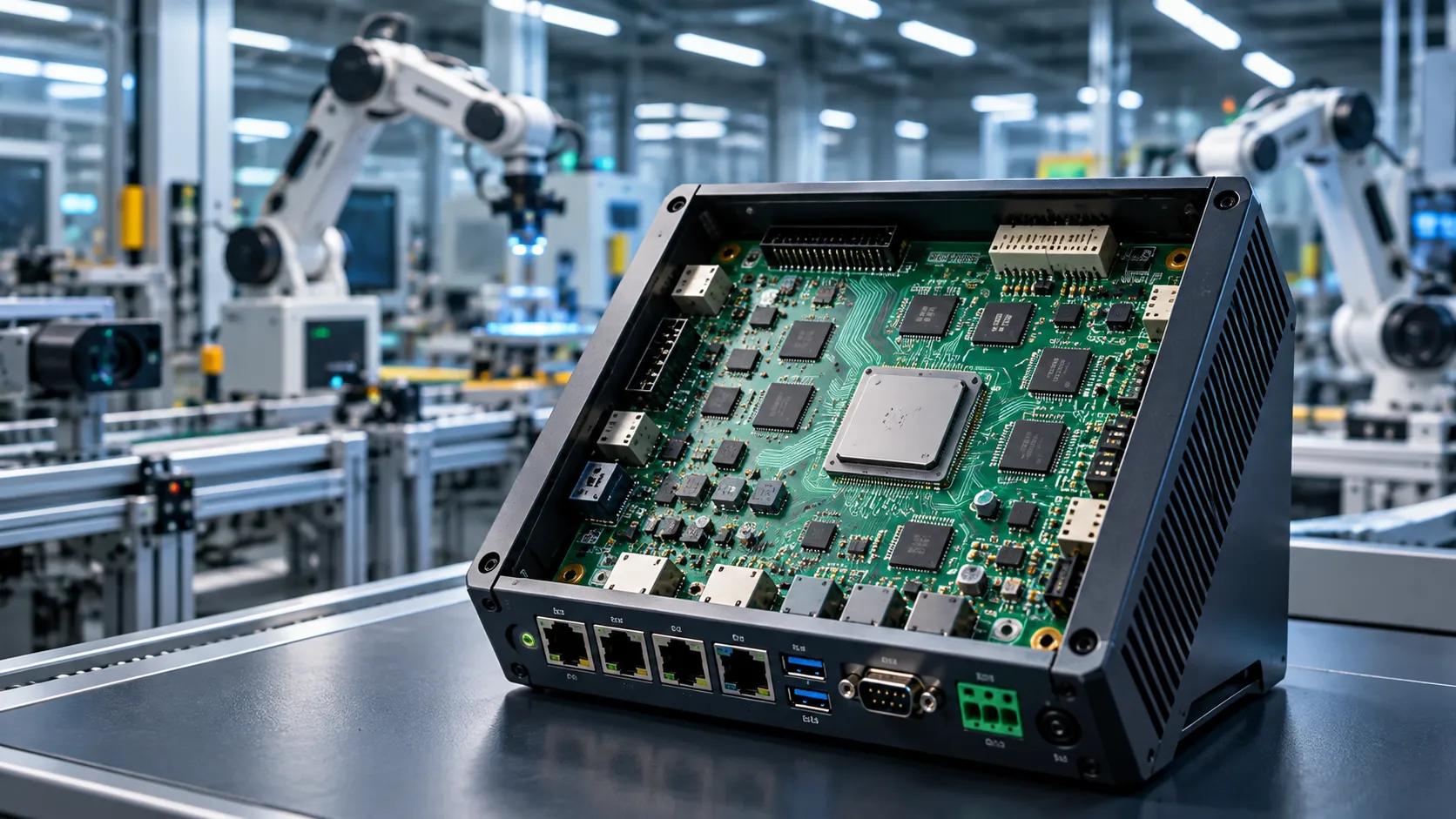
High-Speed Data Transmission Demands Greater PCB Manufacturing Precision
Edge computing devices require continuous data exchange with sensors, cameras, industrial equipment, and cloud platforms. Some devices also perform machine vision, AI inference, and real-time data analysis. As data transmission rates and processing bandwidth continue to increase, some devices use high-speed interfaces such as Ethernet, PCIe, and high-speed storage interfaces, placing greater demands on PCB signal transmission performance.
During PCB manufacturing, conductor width and spacing control, dielectric thickness, etching uniformity, and interlayer registration can all affect impedance consistency and high-speed signal performance. For high-speed PCBs, tighter process control is required in key manufacturing stages such as circuit fabrication, lamination, etching, and impedance control. This helps minimize the impact of manufacturing variations on impedance stability and signal integrity while maintaining consistent product performance.
Higher Integration Places Greater Demands on Multilayer and HDI PCB Manufacturing
Edge computing devices often need to integrate computing, storage, communication, and multiple interface functions within limited space. As some devices evolve toward smaller size, higher performance, and greater integration, multilayer PCBs and high-density interconnect (HDI) PCBs are increasingly used in industrial edge computers, smart gateways, and certain Edge AI devices.
These PCB products place higher requirements on manufacturing processes such as fine-line fabrication, interlayer alignment, lamination, drilling, and plating quality. For products using HDI structures, particular attention should also be paid to laser drilling, microvia quality, and via interconnection reliability
Throughout the manufacturing process, consistent circuit fabrication, hole processing, and interlayer connection quality are essential to reduce the impact of manufacturing variations on electrical performance and long-term reliability.
PCB Material Selection and Loss Control for High-Speed Applications
As the computing performance and data transmission rates of edge computing devices increase, some high-speed PCB applications become more sensitive to the dielectric properties and signal loss characteristics of PCB materials. Particularly in high-speed networking, AI computing devices, and high-speed storage applications, signal transmission performance is influenced not only by material properties but also by dielectric layer control and manufacturing consistency.
For higher-speed signal transmission, the effects of dielectric constant, dissipation factor, and copper foil surface roughness on insertion loss should also be considered. Different PCB materials have different processing characteristics during lamination, drilling, and other manufacturing stages, making it necessary to adjust production parameters according to material properties. For high-speed PCBs using low-loss materials, attention should also be paid to material batch stability and manufacturing consistency to minimize the impact of process variations on impedance control and signal transmission performance.
Power and Thermal Loads Affect Long-Term PCB Reliability
For edge computing devices equipped with high-performance processors, GPUs, or AI accelerators, higher computing loads may result in higher computing loads can lead to increased power consumption and greater heat dissipation demands. Some devices use compact or fanless structures with relatively limited heat dissipation conditions. As a result, PCBs may be exposed to elevated operating temperatures and thermomechanical stress caused by temperature variations during long-term operation.
During PCB manufacturing, attention should be paid to material thermal stability, hole wall copper plating quality, interlayer bonding, and dimensional stability. For PCBs operating for extended periods under elevated temperatures or thermal cycling conditions, appropriate thermal reliability testing can be performed according to actual application requirements to evaluate the reliability of plated through-hole and microvia interconnections under thermal stress under thermal stress.
PCB Reliability Requirements for Different Operating Environments
Edge computing devices are deployed in a wide range of environments. Some are installed in data centers or indoor equipment rooms, while industrial edge computers, transportation equipment, and outdoor edge nodes may be exposed for extended periods to temperature fluctuations, high humidity, dust, mechanical vibration, and other environmental factors.
Therefore, PCB reliability requirements vary depending on the specific edge computing application. For industrial and demanding environments, factors such as material performance, hole interconnection reliability, interlayer bonding reliability, insulation performance, and mechanical stability should be considered according to actual operating conditions. Appropriate inspection and reliability testing should also be carried out in accordance with customer specifications.
It should also be noted that the environmental reliability of an edge computing device does not depend solely on the PCB. PCBA assembly, thermal management, enclosure sealing, and overall equipment protection can also affect long-term operating stability.
Manufacturing Consistency in Volume PCB Production
Edge computing devices are widely used in industrial automation, communications, energy, transportation, smart terminals, and other fields, and some products also require consistent long-term supply over their service life. For these applications, it is important not only for individual PCB production batches to meet specified quality requirements, but also to maintain manufacturing consistency across different batches.
Stable process control and quality monitoring are required throughout key manufacturing stages, including raw material management, inner-layer processing, lamination, drilling, plating, solder mask application, surface finishing, and final electrical testing. Key process parameters and quality data should also be closely managed to reduce batch-to-batch variations and maintain consistency in key parameters such as board thickness, conductor width and spacing, hole diameter, and electrical performance
Evolving PCB Manufacturing Requirements for Edge Computing
As Edge AI, industrial automation, and real-time data processing applications continue to develop, edge computing devices are evolving toward higher computing performance, greater integration, and higher-speed connectivity. Since these devices vary in computing performance, size, and operating environment, their requirements for PCB materials, manufacturing precision, interconnection density, and reliability also differ.
For PCB manufacturers, it is important to continuously improve their capabilities in material selection and processing, precision manufacturing, high-density interconnect (HDI), high-speed PCB manufacturing, and quality control based on the actual application and technical requirements of each product. Maintaining consistency across production batches is also essential to meet the long-term operation and volume production requirements of edge computing devices.
As a professional manufacturer of high-reliability PCBs, HoYoGo has strong capabilities in high-precision, multilayer, HDI, and high-speed PCB manufacturing. We provide PCB manufacturing services tailored to the technical requirements of edge computing devices, industrial computing equipment, smart gateways, AI hardware, and other products. HoYoGo carries out production management and quality control in accordance with customer specifications and applicable industry standards, providing stable and reliable PCB products for a wide range of edge computing applications.


 English
 Français
 Deutsch
 Português
 Pусский
 中文
中文